Sunday, December 21, 2008

The Christmas Sweater by Glenn Beck


This book, written by radio and television host Glenn Beck, is destined to be a holiday classic. I say that not because I am a fan of Glenn's (though I am), but because it contains all the elements to make it so--poignancy, family, faith, forgiveness, atonement and redemption.

Eddie is a 12 year old boy who wants a shiny new bike for Christmas. His father has died, they have had to close the family bakery, and money is tight. But Eddie has dreamed about this bike and believes that somehow his mother will come up with the money to buy it for him. What he receives from her instead is a handmade sweater she crafted with love in her heart. Eddie is too young to realize the real significance of that simple gift and this event sends him on a journey to manhood that has him wrestling with himself, his family and his faith.

Here's an example of some of the wisdom this book contains:

"Most times we're so focused on what we think we want that we can't appreciate how happy we already are. It's only when we forget about our problems and help others forget theirs that we realize how good we really have it."

"When life's perils thick confound you, put His arms unfailing round you."

"...everything happens for a reason. It is up to you to find that reason, learn from it, and let it take you to the place you're supposed to be--not just where you have ended up. You can either complain about how hard your life is, or you can realize that only you are responsible for it. You get to choose: Am I going to be happy or miserable? And nothing. . .will ever change that."

"...no one is meant to carry the load alone. We're all in this together. Once you realize that you can ask for help, your whole world will change."

"Sometimes our strengths are also our weaknessses. Sometimes to be strong you have to first be weak. You have to share your burdens; you have to lean on other people while you face your problems and yourself. That's hard to do, but your family is there to provide a shelter from the storms that come in everyone's life."

"...we can't control what happens to us, but we can control how we react to it. We are all meant to be happy...if you're not happy, it's not God's fault, it's not my fault, or anyone else's fault. It's your own."

"No material thing can [make you happy]...You have to find your way back to the things that will give you lasting happiness, and you can't buy them in a store."

"Everyone needs a place where they can go to just ponder for a while. Silence is important; it's the only time you can hear the whispering of truth. It's funny how many people just look at the surface and never ponder the deeper meaning of things. I guess maybe it's easier that way, because when you skim the surface you blame your problems on the first person you find--and that's never yourself. Maybe that's why people aren't comfortable with silence. Silence makes you think and thinking makes you realize that not all problems are caused by someone else."

"...sometimes we get so entangled in life that we miss the obvious. We just get so caught up in our own problems that most of the time we fail to see what's right under our nose."

"The two most powerful words in any language are 'I am'. Those two words contain all the creative power of the heavens themselves. It was God's answer from the Burning Bush to Moses's question 'Who shall I say sent me?'--I am that I am.' It is the name of God."

"When you choose the path, you choose the destination."

"...life is not meant to be safe. It's only in our mistakes, our errors, and our faults that we grow and truly live...sometimes the hardest part of the journey is believing that you're worthy of the trip."

And this last quote that really sums up the spirit of this captivating holiday book:

"Heaven is the atonement of all things. Atonement. It's a chance to fix the unfixable and to start all over again. It begins when you forgive yourself for all you've done wrong, and forgive others for all they've done to you. Your mistakes aren't mistakes anymore, they're just things that make you stronger. Atonement is the great redeeming and equalizing force that leads to the fulfillment of all things: every hug you've ever longed for...everyone you've loved and lost...Atonement, is heaven on earth."

Saturday, December 20, 2008

Dewey: The Small-Town Library Cat Who Touched the World by Vicki Myron with Bret Witter

This is the story of how a small abandoned kitten transformed a small town library and in the process became famous around the world.

When he was only a few weeks old, on one of the coldest nights of the year, a small kitten was stuffed into the book drop box at the Spencer Public Library. The next morning, the Director of the Library found him, nursed him back to health, and for the next 19 years Dewey Readmore Books won the hearts of all he came in contact with. As his fame grew, he became a source of pride for the Heartland farming town who adopted him and transformed a small library into a meeting place and tourist attraction.

How much of an impact can one cat have? Let me quote Dewey's Mom, the Director of the Library: "He was like one of those seemingly ordinary people who, once you get to know them, stand out from the crowd. They are the ones who never miss a day of work, who never complain, who never ask for more than their share. They are those rare librarians, salesmen, and waitresses who provide excellent service on principle, who go beyond the job because they have a passion for the job. They know what they are meant to do in life, and they do it exceptionally well. Some win awards; some make a lot of money; most are taken for granted. The store clerks. The bank tellers. The auto mechanics. The mothers. The world tends to recognize the unique and the loud, the rich and the self-serving, not those who do ordinary things extraordinarily well. Dewey came from humble beginnings (an Iowa alley); he survived tragedy (a freezing drop box); he found his place (a small-town library). Maybe that's the answer. He found his place. His passion, his purpose, was to make that place, no matter how small and out of the way it may have seemed, a better place for everyone...he never gave up during his long night in the box, and he was devoted to the library that became his home. Dewey didn't do one heroic thing; he did something heroic every day. He spent his time changing lives in Spencer, Iowa, one lap at a time."

This is a heart warming book that captures the specialness of small-town life and the sense of community shared there. It is a story of love and courage and devotion. And whether you are a cat lover or not, you can't help but admire the resilience and humanity of the people of Iowa, and one town in particular, who opened its door and heart to a down and out kitten.

Monday, December 15, 2008

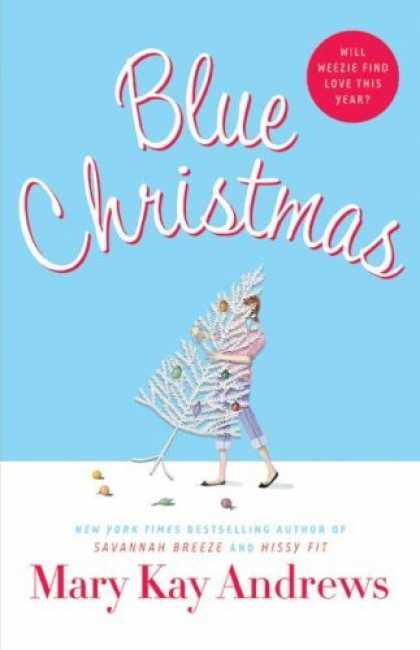
Blue Christmas by Mary Kay Andrews


The holidays can be a time of loneliness and sadness for a lot of people. Many magazines this time of year run articles about how to overcome the holiday blues or holiday depression. For personal reasons, this year I'm having trouble getting into the Christmas spirit. So I decided to pick up this quick holiday read by Mary Kay Andrews and see if it helped.

This is a funny story with quirky characters, lots of southern charm, and a few recipes thrown in to boot. An antiques dealer in Savannah (Weezie Foley) decides to enter a decorating contest in the historical district in which she owns and operates her shop. The only problem is she has some stiff competition from a trendy boutique around the corner, a boyfriend who is moody and withdrawn during the holidays (which is a big distraction), and a decidely odd family who can be more of a hindrance than a help. But Weezie manages to pull off her own Christmas miracle --with the help of the King himself, Elvis--and we find out that sometimes it takes a blue Christmas to put us in the holiday mood. This special edition of her book includes an essay by the author, the aforementioned recipes, and tips for keeping the "happy" in our holidays. Who could ask for anything more?

Thursday, December 11, 2008

Double Dippin by Nicole Falon Garrett

There were many things I liked about this book. First and foremost, it is set in a city that I adore--my kind of town, Chicago. I also like the way the book is organized, each chapter starts with an interesting quote, and is told from the perspective of one of the characters. Thirdly, I like the breezy style of the writing. I thought the author did a very good job lacing humor throughout the book and the conversational tone set with her characters rang true to me. And the title the author picked for her book is perfect, as it works on so many different levels.

Double Dippin takes you into the lives of a group of upper class professionals as they go about their jet setting day to day business. Money is not a problem with this crowd, and at first they seem to be living the good life and extremely happy in their circumstances. But soon secrets begin to emerge, infidelity rears its ugly head, and murder becomes a part of the landscape.

I found the book to be a good romp in the mystery suspense realm. It has a lively pace and the author does a good job of bringing her story alive and making you want to turn those pages to see what happens to her characters next. It is clearly an adult novel and the language is a little graphic in places, and there is sex galore, but that does seem to be the trend these days. Janet Evanovich seems to have carved herself a nice career out of this trend.

So if you want to take a roller coaster ride through the world of power and money set in one of the superlative cities of the world, pick up a copy of Garrett's book.

Wednesday, December 3, 2008

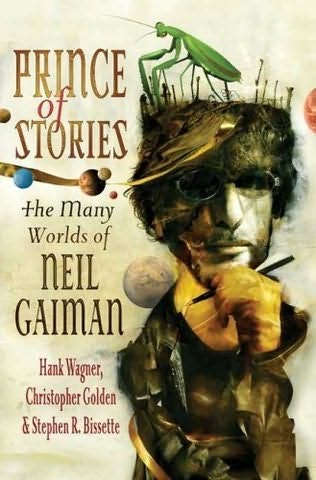
Prince of Stories: The Many Worlds of Neil Gaiman by Hank Wagner, Christopher Golden & Stephen R. Bissette

This book was a must read for me. I happen to be a huge Neil Gaiman fan. As the promo on the jacket says, over the past twenty years, Neil Gaiman has developed into the premier fantasist of his generation, achieving that rarest of combinations--unrivaled critical respect and extraordinary commercial success. He is a pop culture phenomenon and the impact of his work in fiction, film, music, and comic books is unparalleled.

This book is a treasure trove of all things Gaiman. In addition to containing in-depth information and commentary on all his works, it includes rare photographs, artwork, and trivia.

One of the things that impressed me about Neil's early years was the fact that he was about 5 or 6 years old when he read The Lion, the Witch, and the Wardrobe by C. S. Lewis. Yes, that's right, 5 or 6! I was an adult before I ever read the Chronicles of Narnia--I can't imagine reading that book at such an early age. Neil says that he admired Lewis's prose style (found it faultless) and his use of parenthetical statements to the reader, and thought to himself that was so cool that he'd like to do that when he became an author. [Notice how he says when he became an author, not if he ever became an author.]

On his 7th birthday, his parents got him a boxed set of the Narnia books (all seven of them) and he lay on his bed and read them. That's what he did on his 7th birthday! At age 10 he started reading Tolkien. The point is, he was a reader. He loved reading. Reading gave him pleasure. [I can totally relate to this, as I feel exactly the same way.] He said he was very good at most subjects in school, not because he had a particular aptitude in them, but because normally on the first day of school they'd hand out the schoolbooks, and he would read them--which would mean that he knew what was coming up, because he'd read it. He was an incredibly fast and incredibly enthusiastic reader who retained information fairly well. He was a voracious reader who got everything from books. He read more than a book a day, because he always had a book with him and read at any down point.

His parents would drop him off at the library first thing in the morning, and he read his way through the children's library. After he finished, he tried that with the adult library, but found out he couldn't do that with adult books, there were too many, and many he wasn't interested in. But once loose in the adult library, he found he was much more interested in science fiction and fantasy. He jokingly said it got to the point where his parents would frisk him for books before family functions.

What I found interesting is how he turned his love of reading and the written word into writing as a profession. He said one night he could not sleep...just couldn't sleep. He remembered lying there in bed and he had a sort of vision, a train of thought that went--O.K. let's say I'm eighty years old, and I'm on my death bed. And I say to myself, as my life ends, 'I could have been a writer. I could have actually been a writer.' --and he would die not knowing if he was lying to himself or not--and he found that unbearable. He found the thought that he would die thinking he was kidding himself, a terrible thing. He thought it would be better to go and try and be a writer, and to fail, then he would at least know that no, he was put on Earth to be something else. It would be better to do that. It was the worst thing he could think of for himself in the world, at that point, the idea of not knowing if he was lying to himself or not. Because in his heart, he thought he was a writer.

As the book says, Gaiman is a writer, but, first and foremost, he's a fan, a man with a passionate love of story, avidly consuming myths, television, movies, novels, short stories, animation, and comics. He loves to write for writing's sake, and as a means of staying in touch with his legion of fans--his blog, now in its sixth year click here , has over a million unique hits each month. Through it he communicates daily with his fans--those who are devoted to his work.

He truly is the Prince of Stories, and this book is a remarkable chronicle of his work.

Sunday, November 23, 2008

Tis the Season by Lorna Landvik


This is a quick easy read from an author who's twin passions when she was growing up were writing and theater.

Heiress Caroline Dixon has managed to alienate nearly everyone in her life with her alcoholic escapades that became the fodder for tabloids and gossip hungry readers. As she tries to turn over a new leaf and start atoning for past misdeeds, she reaches out to two people who used to be in her life, a former nanny now living in Norway, and a dude ranch owner. In a series of email exchanges we learn more about the depth of Caroline's pain and how she tried to hide it. And the nanny and the cowboy share their own stories. The correspondence leads to the promise of a reunion, just in time for Christmas. And like all holiday stories worth their salt, there are unexpected revelations and redemption and forgiveness.

A lovely Christmas read from a woman the Minneapolis Star Tribune calls a national treasure.

Tuesday, November 18, 2008

Bone Black by bell hooks

I had to read this book as part of the Western Kentucky Literature class I'm taking. I must admit that I was not familiar with bell hooks before the class. She is currently teaching at Berea College and is a well known feminist and social activist. She has published over 30 books and numerous scholarly articles. She addresses race, class, and gender in education, art, history, and the mass media. This book is a chronicle of her girlhood memories growing up in western Kentucky, her little corner of the south. She was a strong-spirited child who does not fit in and finds comfort in solitude and the company of books. It is ultimately in the world of stories and poems that she finds home and belonging.

This is a book with emotional resonance and lyrical language. Here is a small sample from one of the chapters to show the raw honesty of what she writes: "She wants to express herself--to speak her mind. To them it is just talking back. Each time she opens her mouth she risks punishment. They punish her so often she feels they persecute her. When she learns the word scapegoat in vocabulary lesson, she is sure it accurately describes her lot in life. Her wilderness, unlike the one the goat is led into, is a wilderness of spirit. They abandon her there to get on with the fun things of life. She lies in her bed upstairs after being punished yet again. She can hear the sound of their laughter, their talk. No one hears her crying. Even though she is young she comes to understand the meaning of exile and loss. They say that she is really not a young girl but an old woman born again in a young girl's body. They do not know how to speak the old woman's language so they are afraid of her."

Though some of her writing can be a bit strident, I think she is at her best when she is talking about the personal and being passionately honest. This book will stay with you long after you have finished it. Those are the best kind.

Monday, November 17, 2008

This book is a strangely fascinating look at all things weird in the state of Kentucky. As the book jacket says, who knew My Old Kentucky Home could be so weird? Most people when they think of Kentucky probably think of the Derby and Colonel Sanders Kentucky Fried Chicken. But Kentucky is so much more than that. As this book shows, the state is full of local legends and unusual sights, some supernatural, some odd, and some just plain weird. This is a brand new entry in the Weird U.S. series, and it's packed with all that great stuff you won't get anywhere else. The graphics and pictures are wonderfully displayed and this book is just pure fun to delve into shallow or deep. Check out the cave mummies found in Kentucky caves, the mysterious mounds of Wickliffe, the legend of the blue people in the bluegrass state, the strange doings at the Seelbach hotel, Murray's vampire clan, the Stanford UFO abduction, and many, many more.

Sunday, November 9, 2008

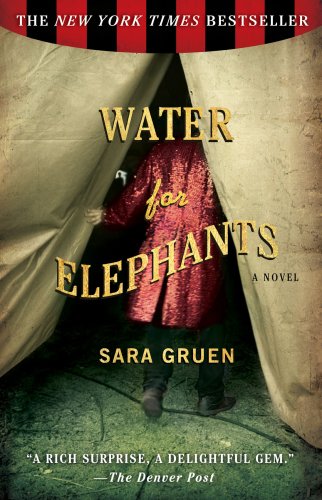
Water for Elephants by Sara Gruen


This book was our November selection for the Book Club, and we had to wait almost a year to get it in the large print kits that come from the state, but I must say it was worth the wait.

I have always been enamored of elephants and think they are amazing creatures. Elephants have one of the longest lifespans in the animal kingdom and live almost as long as human beings. They are the largest land animals and use infrasound (a low sound inaudible to humans) to communicate with each other over distances of several miles. Elephants have the best sense of smell of the world's animals and the tip of an elephants trunk contains the most sensitive tissue ever studied. And elephants grieve for dead companions, something that is virtually unknown in other animals.

This book is about the world of the circus, but it is so much more than that. Sara Gruen introduces us to a world of freaks and misfits and a struggling second rate circus that is trying to stay alive in the midst of the Great Depression. She draws vivid characters into a superb plot full of gritty historical detail and concisely brings this lost world to life in her fast paced story. She manages to humanize the midgets, drunks and freaks who populate her story and even manages to give us an amazing glimpse at what it's like to grow old.

Jacob Jankowski, a veterinary student who has almost earned his degree, is suddenly orphaned, jumps onto a passing train, and finds himself hired on as the vet for the Benzini Brothers Most Spectacular Show on Earth. There he meets and falls in love with the beautiful Marlena, the star of the equestrian act, who unfortunately happenes to be married to the charismatic but darkly twisted August, the animal trainer. And then of course there is Rosie, an elephant they manage to pick up along the way from another circus that has gone under and seems untrainable until a way is discovered to reach her.

This is a beautifully written lovely and mesmerizing book. It is a compelling journey, not only into the heart of the circus, but also a book that tells us much about what animals can teach people about love.

Tuesday, November 4, 2008

Amazon's Best Books of 2008


Out of the thousands of new releases, this is Amazon's Top Ten Editors' Picks

The Northern Clemency by Philip Hensher
Hurry Down Sunshine by Michael Greenberg
Nixonland by Rick Perlstein
The Forever War by Dexter Filkins
The Story of Edgar Sawtelle by David Wroblewski
The Likeness by Tana French
Serena by Ron Rash
The Lazarus Project by Aleksandar Hemon

Top Ten Amazon Customer Favorites:

Breaking Dawn by Stephenie Meyer
The Last Lecture by Randy Pausch
Brisingr by Christopher Paolini
The Story of Edgar Sawtelle by by David Wroblewski
The Appeal by John Grisham
In Defense of Food by Michael Pollan
The Revolution by Ron Paul
The Host by Stephenie Meyer

Top Amazon Sellers in October

The Snowball by Alice Schroeder
Brisingr by Christopher Paolini
The Shack by William P. Young
Twilight by Stephenie Meyer
Breaking Dawn by Stephenie Meyer
New Moon by Stephenie Meyer
Eclipse by Stephenie Meyer
The Love Dare by Stephen Kendrick
The Lucky One by Nicholas Sparks
Hot, Flat, and Crowded by Thomas L. Friedman
The Story of Edgar Sawtelle by David Wroblewski
The Tales of Beedle the Bard by J.K. Rowling
The Limits of Power by Andrew J. Bacevich
  • They have lots of other interesting categories you may want to check out: Best in Audio, Cooking, Art and Photography, and Teens, to name a few. Check it out here.

Saturday, November 1, 2008

Ghosts of Russell County

Aron Houdini and the guillotine that once belonged to Houdini


Ghosts of Russell County was held at the Star Theater on October 23rd. Roberta Simpson Brown and her husband Lonnie Brown are usually part of the program, telling their ghostly tales. This year they were unable to participate in the program due to emergency bypass surgery that Lonnie had to undergo. Lynwood Montell (author of Ghosts Across Kentucky and Ghosts Along the Cumberland) usually participates as well, but this year had a prior commitment and was unable to take part.

So this year we had to do things a little bit different. We had several guest readers who read selections from Roberta Simpson Brown and Lynwood Montell's books. We also had Nash Black (the husband and wife writing team of Ford Nashett and Irene Black) with us and they brought along their new book Haints and treated us to a few stories from it.


Cody York reading "A Father's Faith" from Haints

Elizabeth Wright reading "The Touch" by Roberta Simpson Brown


Renee Daffron reading "Flower Girl" by Roberta Simpson Brown


Lea Turner reading "Don't Go There" by Nash Black


David Smith reading death lore from Montell's book, Ghosts Along the Cumberland


Benjamin Foster and I singing acapella version of "Oh Death"


Ford Nashett reading "Death Mines" from Haints


And then to close out the show we had a young man who bills himself as "The World's Only Living Houdini", Aron Houdini. Aron, who is a master of magic and illusion treated us to a few feats of magic and then gave a presentation with slides about his experience in the Death Tunnel at Waverly Hills Sanatorium in Louisville.
  • For those of you interested in finding out more about the Waverly Hills Sanatorium, please click here. Another good site is spookedtv.com
And if you are REALLY interested in ghosts
And one last site I can't help but mention, because it has to do with haunted libraries.
  • Check this one out here.
See you all next year at Ghosts of Russell County!

Sunday, October 26, 2008

The Simple Living Guide by Janet Luhrs


The author of this book, Janet Luhrs, has edited and published a journal titled Simple Living since 1992. In the Introduction to this book (called Living Deeply) she starts with a quote from Thoreau where he says he went to the woods because he wished to live deliberately. She then proceeds to define "living deliberately", and in doing so really sums up the whole philosophy of her book. She says it's not about how much income you have, or giving up your car, or never traveling. She says it's all about choosing your existence rather than sailing through life on automatic pilot. You choose things consciously, they don't just happen. You live consciously...deliberately...and thoughtfully, being fully present and fully aware. You live intimately...closely tied to the people, places, and things in your life. When you simplify, you'll have space and time to know and love people in a deeper way. This book is about the different paths people have taken in order to slow down and live more fully. Simplicity is not just one thing, one path. The author asks many really excellent questions: When did we decide that more and bigger stuff would give us a better life? When was the last time a busy calendar gave anyone more serenity? Do we really get more joy from worrying about, rearranging, and dusting our things than we do from visiting with a friend in an intimate way? A certain level of material comfort is necessary. We all need our own nests, food, and clothing in order to survive. We need some kind of work to do, paid or unpaid. And as human beings, we need more than the bare minimum; we need a certain level of aesthetics. The trouble is, says this author, most of us don't know when to stop. We get to a certain level of comfort and then think, "This feels nice, I'd better strive for more." The next thing you know we are buried in debt, stress, and complication. We've lost our fire, our passion for life. This book will help you get it back.

The Hearts of Horses by Molly Gloss

I read this book because it was a book club selection for our local Book Club, "The Porch Page Turners". One of the ladies in the club likes westerns and we hadn't read a western in awhile. I picked this one because it was one of the few westerns the state had available in kit form (meaning that we receive multiple copies of the book) that would fit our schedule. And I must say I'm glad that I did, because I really liked this book.

I didn't know anything about the author, Molly Gloss, but after reading the book discovered a link to an NPR interview with her on Morning Edition, here. There is also an excerpt from the book so you can tell whether you might like to read it or not.

The book concerns a 19 year old big boned girl wearing chaps, named Martha Lessen, who in 1917 is looking for the cowboy way of life. She shows up at the ranch of George Bliss and he hires her, because many of his usual hands are off fighting the war. She sets up a circle of horses to train in this remote county in Oregon and sets about training them in her own way. In the process she helps a family save their horses when their wagon slides into a ravine, she gentles a horse for a man dying of cancer (his last gift to his young son), and clashes with a hired hand who is abusing horses. And always there is the lore about the gentling of horses, which I found fascinating. The scene of the young rancher's last lucid moment with his wife and son before he succumbs to cancer is tender, elegant, and sweet in the hands of such a superb writer...not the least bit maudlin...just right on target where our emotions are concerned.

Martha is painfully shy with people, but great with horses, especially in reading the body language of often panicked and wild animals. She is a female horse whisperer trying to make a go of it in a man's world. And therein lies the beauty in this book. Molly Gloss is a skilled western myth buster. In the western stories of L'Amour and Zane Grey you don't hear much about the women. In fact most of western literature does not give you much from the women's point of view. Molly does a wonderful job making you feel part of the circle of conversation with the women in the story and does a great job with the history of the country and how one corner of the west was changing at the time of her story. I found her characters well drawn, her dialogue pitch perfect, and I was moved in profound ways by her characterization of the people and especially the horses who are always at the mercy of the people who own them.

After reading up on the author, I understand she has written several books that feature tough, smart, independent women, that lyrical descriptions and unforgettable characters are common in her work, and that she has dry wit and heart. I know that I will read other books by her just as soon as I get a chance to. Maybe you should give her a try too.

Wednesday, October 15, 2008

The Graveyard Book by Neil Gaiman


I love Neil Gaiman. I love his accent. I love his humor. I love his leather jacket (that is his trademark), I love the slighly askew way he looks at you when he talks. And most of all, I love his writing.

My favorite quote about the book was from Joe Hill, Stephen King's son (author of Heart–Shaped Box), who said "The Graveyard Book is everything everyone loves about Neil Gaiman, only multiplied many times over, a novel that showcases his effortless feel for narrative, his flawless instincts for suspense, and above all, his dark, almost silky sense of humor."

Nobody Owens (or Bod to his friends) lives in a graveyard. He has lived there since escaping an attack from a man named Jack, who killed the rest of Bod's family. He was raised and educated by ghosts (because it takes a graveyard to raise a child), and cared for by a guardian who belonged to neither the world of the living or the dead. There are dangers and adventures in the graveyard that Neil handles with his usual inimitable aplomb. Neil himself says this book was inspired by the original Jungle Book of Rudyard Kipling. Just replace the animals with ghosts and the supernatural.

All the praise heaped upon this book, and its author in particular, are well deserved. I have never seen anyone able to combine horror, action, humor and a great deal of just old fashioned humanity in the same way that he does. I listened to the author himself read his book at the Neil Gaiman website for Young Readers here. And I must say that the end of the book was so sweet that it made me cry. Doesn't sound like your typical reaction to this kind of book, but in Neil's hands we are all putty.

As we approach Halloween, a holiday that is rivaling Christmas in popularity, the interest in all things ghostly and supernatural is at a peak and this book is a delightful treat for readers of all ages

Monday, October 13, 2008

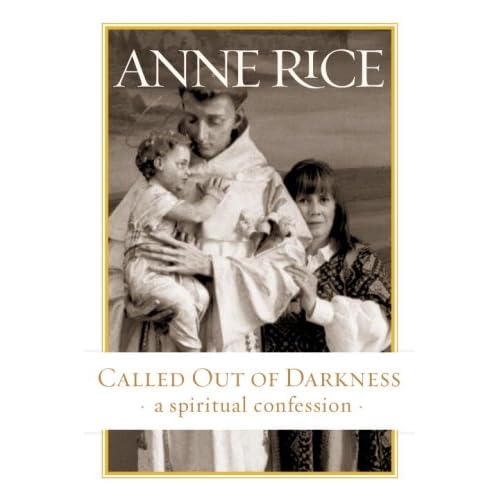
Called Out of Darkness: a spiritual confession by Anne Rice

Ann Rice was a poor reader. She was 27 before she began an undergraduate degree in English and 32 before she earned a masters in English. Up until first grade, she was called Howard Allen (the name she was born with, which was a combination of her father’s name and her mother’s maiden name). Her parents thought the male name of Howard would be a great asset to her and that she was going to do great things.

She was a devout child raised in a deeply religious Irish Catholic family. She came out of Catholic school with knowledge of the important people and incidents of the Bible, but no real sense of its distinctiveness, or its poetic qualities. She had very little sense at all of the Bible’s voice.

She went through the eighth grade being schooled only with girls. For two years she experienced a coeducational Catholic high school, after that went to a Catholic girls’ academy for a year, and then, finally when her family moved to Texas she experienced public school for the first time.

Around freshman year of high school she began to read. The first novel that she enjoyed and loved was Great Expectations by Charles Dickens. The other novel she discovered was Charlotte Bronte’s Jane Eyre. But books were still hard for her to penetrate and she continued to listen for her knowledge and hang on to words of those who said interesting things. When she entered an all girls college she responded strongly to complete lectures which enabled her to learn without the necessity of cumbersome and difficult books. Her life became happy, though she made less than perfect grades because she wasn’t considered an effective writer and she considered the atmosphere of her classes disciplinary and confining. The one story she submitted to a college literary magazine was rejected.

She dreamed of being a violin virtuoso, but was not talented, so felt shut out of the realm of music. She already felt shut out of book learning, and the realm of childhood. She felt extremely uncomfortable being called a child, she didn’t “get” what childhood was, and felt she was a failure as a child. This would become a great theme in her novels—how one suffers from being an outcast.

Anne ultimately left the church because it had become for her “anti-art and anti-mind.” It was an estrangement that lasted for 38 years. She says she felt a new relaxation, and a new passion for life, but a certain bitter darkness too. In a world without God anything could happen and there would be no justice for the poor and those who died at the hands of tyrants. And so she began her secular journey. She married Stan Rice, a committed atheist, and the marriage lasted for 41 years, until his death in 2002. She had a daughter who died from leukemia before her sixth birthday. Then came the book Interview with the Vampire which made her a household name.

She wrote 21 books before her faith returned to her, and curiously it was the meticulous research she did for them, the digging through history, the studying of ancient history in particular (a Rice hallmark) that actually lay the groundwork for her return. The more she read of history—any history—the more her atheism became shaky. History, as well as Creation, was talking to Anne about God. In particular, in the survival of the Jews Anne saw something that there was no convincing sociological or economic explanation for at all. Anne says “A great love of the Jewish people began to burn in me, a love of this tribe that had survived since the most ancient times into the present day. I conceived a fierce curiosity about them, and everything pertaining to them. I was drawn to them in their piety and integrity. And I wanted to know how Christianity had arisen from their religion, and how, above all, had it managed to take the Western world by storm. If any one “thing” in all my studies led me back to Christ, it was His people, the Jews.”

This book explores her heartfelt return to her faith and gives us a glimpse into her interior pilgrimage.

Tuesday, October 7, 2008

Edgar Allan Poe died on this day in 1849

The Master of the Macabre died in Baltimore on October 7, 1849. But the cities of Philadelphia and Baltimore are locked in a dispute as to which city has the larger claim on him. He is buried in Baltimore, where he died, but some Poe scholars say he was living in Philadelphia when he produced much of his best work (including some of the best detective mysteries ever written).

There has been much disagreement as to the cause of death. It has been postulated that he died of rabies. The author of that hypothesis says Poe entered Washington College Hospital comatose, but by the next day was perspiring heavily, hallucinating and shouting at imaginary companions. The following day, he seemed better but could not remember falling ill. On his fourth day at the hospital, Poe again grew confused and belligerent, then quieted down and died.

That is a classic case of rabies, the author said. In the brief period when he was calm and awake, Poe refused alcohol and could drink water only with great difficulty. Rabies victims frequently exhibit hydrophobia, or fear of water, because it is painful to swallow. This study is in the September 1996 issue of The Maryland Medical Journal.

Although it has been well established that Poe died in the hospital, legend has it that he succumbed in the gutter, a victim of his debauched ways. The legend may have been fostered by his doctor, who in later years became a temperance advocate and changed the details to make an object lesson of Poe's death.

Some say Poe almost surely did not die of alcohol poisoning or withdrawal. The writer was so sensitive to alcohol that a glass of wine would make him violently ill for days. Poe may have had problems with alcohol as a younger man, but by the time he died at 40 he almost always avoided it.

An unknown visitor has paid homage to Poe's grave every year since 1949. Due to the length of this tribute it is likely that several individuals are involved. But every January 19th in the wee hours of the morning they make a toast of cognac to Poe's original grave marker and leave 3 roses. They have been affectionately referred to as the "Poe Toaster".

Poe contributed to the genre of science fiction, as well as being a poet and critic. Here's a wonderful link to a searchable collection of his works.

Edgar Allan Poe

Wednesday, October 1, 2008

For the Book Lover

Here's a good resource for all you book lovers out there. The next time you catch yourself thinking you're in the mood to read something, but you just don't know what, it might be a good idea to open this book and do a little perusing. The author (an award winning book reviewer for the Boston Globe, who loves, loves, loves books) has listed about 80 different moods with a sampling of books offered under each topic. She gives a brief description of the book, and any awards it may have won. Moods range from "A Good Laugh" to "A Good Cry" and many in between, including "For Romance", "For Revenge", "For Hope", "For Heartbreak", and "To Survive". There is a rating system for each book with associated icons representing the various categories. The ratings are: Literary Merit, Provocative, Influential, Inspirational, Humorous, Brainy, Easy Reading, Page Turner, Challenging, Bathroom Book, Family Friendly, Movie (Books that have been made into a movie).

For example, under the category "...to Remember Mama" she has listed one of my all time favorite books "All Over But the Shoutin' " by Rick Bragg. For literary merit she gives it two stars (out of four possible). [Here, I think I would differ with her assessment...seems to me that there is a slight bias against southern authors in a couple of her ratings, I would have been a little more generous]. And she rates it provocative, inspirational, humorous, and a relaxed easy read. Also in this category she lists "Mama Makes Up Her Mind: And Other Dangers of Southern Living" by Bailey White (another one of my favorites). Again she gives it two stars for literary merit and rates it funny, a relaxed easy read, and a bathroom book.

The fun parts of this book for me were her quirkier categories like "To Save the World", "To Defy Expectations", "To Revel in Words", or "To Suffer No Fools". And it was interesting to see how her tastes in books ran and whether it was counter to mine, as well as pick up a few good tips for books I hadn't managed to read yet and make a notation in my brain about when I might want to pick them up and read them according to the emotional state they matched. As the book jacket says, Hallie Ephron serves up a literary feast, sure to satisfy your emotional appetite.

Sunday, September 14, 2008

Cowboys and the Internet

Since this blog is called "Reader's Corner", most of the things I post will be book reviews. But occasionally I will post things that I've come across that I find interesting, or write about something I've been thinking about, that have to do with the world of books and reading


Recently I read an article at Economist.com called "Why Cowboys Read" that was complimentary to libraries in this internet era, but one of the things that surprised me in the article was the fact that Wyoming residents checked out nine books in 2005-2006 compared with an average of five in California and two in Washington, D.C. I wondered how Kentucky measured up to these numbers. After doing a google search and coming across the National Center for Education Statistics, I found out that Kentucky ties with California (not as good as Wyoming, but not as poor as Washington, D.C. either). For years I have kept a list of the number of books I have read in a year. During good years, I have read as many as 51, and in poor years I have read as little as 15. That's probably better than some and a whole lot worse than others. But I would certainly be more comfortable in my profession and also with the country in general if these statistics were at least in the double digits for a year's time.


Another interesting thing I came across lately was an article at the Atlantic.com called "Is Google Making Us Stupid?" This one made me really stop and think, because as a Librarian I use Google a lot (just like I'm sure the average internet user does). No wonder we all love Google. It gives us what we really want: an end to our search, our questions answered, instant knowledge. It gives us the instant gratification we all crave. But Nicholas Carr says it exacts a price, and I think he makes a lot of valid points. See what you think.

Saturday, September 13, 2008

Black Belt Patriotism: How to Reawaken America by Chuck Norris

I have always loved Chuck Norris, even before he became fodder for a book called "The Truth About Chuck Norris: 400 Facts About the World's Greatest Human" by Ian Spector. I'm sure you've heard the jokes going around the Internet: Guns don't kill people, Chuck Norris does; Chuck Norris can eat just one Lay's potato chip; Chuck Norris's blood type is D.O.A.; and Superman owns a pair of Chuck Norris's pajamas. But Chuck is much more than a 6 time world karate champion who retired undefeated. He's an actor, political activist, and humanitarian. In 1988 he wrote his autobiography "The Secret of Inner Strength" that became a New York Times best seller and then followed it up with "The Secret Power Within".

In this book Chuck outlines what he thinks are the 8 most important challenges we face as a country

1) No national legacy
2) No control over spending
3) Not enough border control
4) No moral compass
5) Not enough value for human life
6) No future for children
7) No traditional values
8) No might to fight

He has appendices that include the Declaration of Independence, the Constitution of the United States, and the Ten Commandments.

In ten practical chapters he gives us insights from our founding fathers applying that wisdom to the problems of today. Among other things, he says we need to recall the purpose of government, return to a pay-as-you-go government, implement a fair tax (the ultimate economic stimulus package), cultivate a culture of peace to curb spending, secure and protect our borders, reclaim the value of human life, protect and reconnect our youth, honor and care for the family, educate ourself on health and nutrition so we will be fit for the fight, and finally reawaken the American Dream. Sounds like a pretty attractive proposal to me. Why don't you see what you think by picking up a copy of this book.

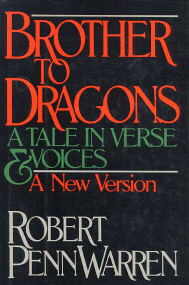
Brother to Dragons by Robert Penn Warren

[There are several versions of this book. The version I read is from 1979]

[The title is a Biblical reference, Job, 30:29, listing his reasons to mourn: "I am a brother to dragons and a companion to owls."]

The year is 1811, "annus mirabilis," the year during which history records strange happenings. Floods change the courses of rivers, create lakes, sickness strikes the valley dwellers, squirrels migrate in huge numbers, pigeons scour the grain fields, a total eclipse of the sun, tornadoes, hurricanes, earthquakes rock the county. And in December of 1811 a savage crime was committed. A negro slave was brutally murdered. The perpetrators of this crime were the nephews of Thomas Jefferson--sons of his sister Lucy. Lilburne and Isham had the slave tied to a table in the meat-house and hacked him to death with an axe, casting his mutilated body parts into a roaring fire before the eyes of the other slaves. The supposed reason for this brutality was that the slave had broken a favorite pitcher of Lilburne and Isham’s dead mother. Eventually news spread about the murder (a fire-blackened bone was discovered, having been sniffed out and gnawed by a curious dog) and the brothers were arrested and indicted. After they were released on bail, Lilburne convinced his younger brother to engage in a suicide pact, according to which each brother would fire a fatal shot simultaneously into the other. Things did not go according to plan, and Lilburne was killed, while his brother survived unscathed. Isham was taken into custody again, but escaped and fled before being brought to trial.

Jefferson, despite the fact that the act was common knowledge, apparently could not bring himself to comment on or even acknowledge it, possibly because he could not accept that he, such a wealthy, prominent leader, could carry within his blood the capacity to perform such evil.

Robert Penn Warren in this long narrative poem examines the fact that while we are capable of great good, we are also capable of despicable evil. The events leading up to the murder, and the more astonishing aftermath, provide the framework for the poem. He uses multiple voices in his poem in order to give the reader a sense of fairness and lend more authority to his text. So we have a list of characters that includes Thomas Jefferson (the third President of the United States), Meriwether Lewis (with Clark, the co-commander of the Voyage of Discovery), Colonel Charles Lewis (Husband of Lucy Jefferson), Lucy Jefferson (sister of Thomas Jefferson), Lilburne Lewis (son of Charles and Lucy), Letitia Lewis (wife to Lilburne), Aunt Cat (a slave in the household of Charles Lewis, and black Mammy to Lilburne), Brother (to Letitia Lewis), Isham Lewis (brother to Lilburne), and John (the young slave). Warren himself is also a participant in the story as he moves in and out of the text contributing to the dialogue. Instead of setting the poem in 1811 and making it a traditional historical narrative, he has a set of characters meeting at a place and time not named to try and make sense of their actions.

Warren alludes to a human nature at odds with Jefferson's vision of perfectible humanity. But it is the inherited violence of slavery that profoundly impacts everybody in the poem, black and white. The ramifications of slavery are so widespread that all the poems figures are somehow complicit in the brutal act. And by inference that complicity extends to every reader.

This narrative poem says a lot about the human condition and the nature of the human heart. It's an extraordinary book.

Saturday, September 6, 2008

Aunt Jane of Kentucky by Eliza Calvert Hall


"Eliza Calvert Hall" was the pen name of Mrs. Eliza (Lida) Calvert Obenchain (1856-1935), a native of Bowling Green, Kentucky. This book is well known for it's gentle folk wisdom, provided by an elderly fictional Aunt Jane, a plain old Kentucky woman. But it is more than a collection of reminiscences about the region of Western Kentucky where the author was born and raised. The author worked hard to win rights for women in the areas of property ownership and divorce.

The first entry is called Sally Ann's Experience. It pits a group of women against the organized church. It was first published in Cosmopolitan in 1898. This one piece was popular in Chautauqua performances in the early twentieth century and even prompted Teddy Roosevelt to say in a speech in Lansing, Michigan in May of 1908 "I cordially recommend the first chapter of Aunt Jane of Kentucky as a tract in all families where the menfolk tend to selfish or thoughtless or overbearing disregard to the rights of their womenfolk."

These stories recall Sunday dinners, church meetings and county fair competitions and her lively and folksy comments are often sly comments on the society of her time. Her insights on women's lives and work are showcased in these clever tales. As an example, at one point in her essay "The New Organ" after an old yellow rooster flutters up to the door-step and crows ominously Aunt Jane says "There, now! You hear that?...There's some folks that gives right up and looks for sickness or death or bad news every time a rooster crows in the door. But I never let such things bother me. The Bible says that nobody knows what a day may bring forth, and if I don't know, it ain't likely my old yeller rooster does."

Humor plays a big part in this book and the tales are delightfully told. She uses eccentric characters to illustrate simple values, and she does it in such a way that no one would take offense. It is comforting to go back in time to a community where everybody knew one another and people worked together despite their differences. That is part of the charm of this book. This is what accounts also for the popularity of books like Jan Karon's The Mitford series.

In a story called Mary Andrews' Dinner-Party the character Aunt Jane says "He preached about Nebuchadnezzar and the image he saw in his dream with the head of gold and the feet of clay. And he said that every human being was like that image; there was gold and there was clay in every one of us. Part of us was human and part was divine. Part of us was earthly like the clay, and part heavenly like the gold. And he said that in some folks you couldn't see anything but the clay, but that the gold was there, and if you looked long enough you'd find it. And some folks, he said, looked like they was all gold, but somewhere or other there was the clay, too, and nobody was so good but what he had his secret sins and open faults. And he said sin was jest another name for ignorance, and that Christ knew this when he prayed on the cross, 'Father, forgive them, for they know not what they do.' He said everybody would do right, if they knew what was right to do, and that the thing for us to do was to look for the gold and not the clay in other folks. For the gold was the part that would never die, and the clay was jest the mortal part that we dropped when this mortal shall have put on immortality."

I think the character Aunt Jane was presented as loving life and enjoying it and not just enduring it, and she seemed to live a very happy and fulfilled life, and believed that there was value in all spheres of women's life and work. I think that is a very endearing lesson for all of us and that is why this book is popular still to this day.
Related Posts Plugin for WordPress, Blogger...