Thursday, July 25, 2013

The Healing by Jonathan Odell


"Like The Help, that showstopping work by Kathryn Stockett, The Healing is another Mississippi-born work of art, and Odell's Polly Shine is a character for the ages."  This quote by Pat Conroy on the cover of the book is about one of the main characters.  And I admit, she was my favorite character as well.  Full of back woods wisdom about herbs and remedies and the source of some of my favorite quotes from the book.  "Sometimes when you look at a person all you see is the tangle and you miss the weave."  Or this one:  "A flapping tongue puts out the light of wisdom."

Odell's beautiful historical novel illustrates the connective power of story to heal body, mind, and community.  Rich in mood and atmosphere, this story about the unbreakable bonds between three generations of female healers is a marvelous book of reverberating beauty.

Plantation mistress Amanda Satterfield's grief over the loss of her daughter crosses over into madness.  She takes a newborn slave child as her own and names her Granada.  Troubled by his wife's disturbing mental state and concerned about a mysterious plague sweeping through his slave population, Master Satterfield purchases Polly Shine, a slave woman reputed to be a healer.  But Polly's sharp tongue and troubling predictions cause unrest.  Polly recognizes "the gift" in Granada, and a domestic battle of wills ensues .  Seventy-five years later, Granada, now known as Gran Gran, must revive the buried memories of her past in order to heal a young girl abandoned to her care.


Thursday, July 11, 2013

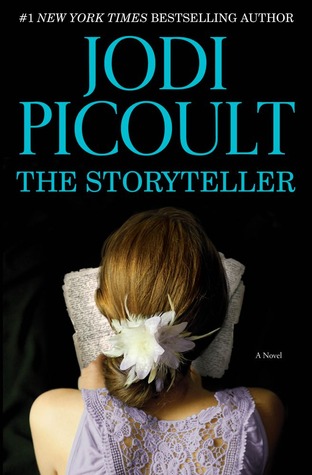
The Storyteller by Jodi Picoult


Jodi Picoult likes to tackle hot button issues in her fictional narratives, and this time out the framework of The Storyteller is World War II and Nazi war crimes and the huge issue of "forgiveness." 

A 95 year old widower and retired school teacher in New Hampshire, Josef Weber, claims to be a Nazi war criminal.  He confesses this to Sage Singer, a woman he meets in a grief support group, who is a 25 year old baker with a nasty facial scar from an accident.  More importantly, Sage is Jewish.  Josef asks Sage to help him die.  Sage has a grandmother, Minka, who is a holocaust survivor (from Auschwitz).  Sage never really knew her grandmother's story.  In the process of trying to decide how she will react to Josef's confession and his plea for her to help him die to atone for his sins, we learn Minka's brutal story of survival.

Our attitudes, fears, hopes, and values are strongly influenced by storytelling.  Before literacy or written language, storytellers functioned like today's mass media:  they could entertain, they could inform, they could explain, they could transmit the culture's myths and treasured stories from one generation to the next. And because they did these things in an engaging and interesting manner, people paid attention and learned. Fiction seems to be more effective at changing beliefs than writing that is specifically designed to persuade through argument and evidence.  The more we are absorbed in a story, the more it can change us.  When we are absorbed in a story, we drop our intellectual guard and are moved emotionally.  At its heart, storytelling is a gift.

Picoult is a good storyteller.  This book grapples with complex moral issues and peels back the layers of human emotion while examining the human condition up close and personal.   She takes a penetrating look at the nature of good and evil to produce a powerful and thought-provoking book.  The seed for writing this book came from Simon Wiesenthal's The Sunflower, about his time in a Nazi concentration camp, and Picoult includes an Author's Note at the end recommending several additional resources she found helpful in writing the book for those who would like to learn more about that period of our history.     

Sunday, June 23, 2013

Alice I Have Been by Melanie Benjamin

 
Few works of literature are as universally beloved as Alice's Adventures in Wonderland by Lewis Carroll.  In this historical novel we meet the young girl who was the muse for our unforgettable trip down the rabbit hole, Alice Liddell.  It blends fact and fiction to tell us Alice's story, from the time she was a young girl and captivated the heart of Carroll, on through into her adult life and later years.
 
The friendship between Alice and the man she knew as the Rev. Charles Lutwidge Dodgson (Carroll's real name) has been the subject of speculation by many of his biographers (for after all, when they first met Alice was around 5 and Dodgson was 26; and some of those pictures can seem a bit unsettling by today's eyes).   
 
 
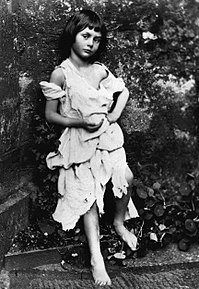
Liddell dressed up as a beggar maid, 1858 (photo by Dodgson)


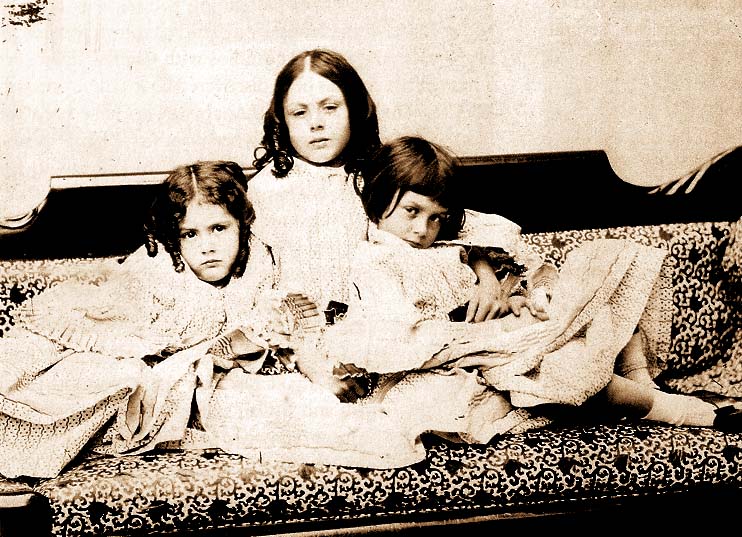
Dodgson went on many outings with Alice and her two sisters.  He was a mathematics teacher at Oxford and the Liddell sisters were the daughters of the Dean there. Like many Victorian bachelors, he became a sort of uncle to his friends’ children, making up stories and games and taking them on short trips. 

Alice and her sisters, 1859 (photo by Dodgson)


Alice was 10 when Dodgson told her his story of a little girl who fell down a rabbit hole, and she begged him to write this one down.

Of the approximately 3,000 photo­graphs Dodgson made in his life, just over half are of children—30 of whom are depicted nude or semi-nude. Some of his portraits—even those in which the model is clothed—might shock 2010 sensibilities, but by Victorian standards they were...well, rather conventional. Photographs of nude children sometimes appeared on postcards or birthday cards, and nude portraits—skillfully done—were praised as art studies.

I do stress that this is a work of fiction (not biography), but I found the book strangely compelling and it is one interpretation of how things might have occurred. 

Finding Camlann by Sean Pidgeon

 
I have always been a fan of literary forays and Arthurian legend, so I looked forward to reading this book.  And while I enjoyed the book, I think some that aren't quite as enamored of the backstory as I am might enjoy it a little less.  Essentially, this is the plot:  A recently divorced archaeologist, Donald Gladstone, is trying to discern the true origins of the Arthurian story.  The few fragments of chronicle and verse that mention him by name are enticing, but they do not prove his existence.  He soon meets a linguist, Julia Llewellyn, who works on the Oxford English Dictionary staff.  She agrees to help him in his search.  This quest becomes an intellectual and emotional journey in which we examine love in all its many guises (that between parents and children, professors and their students, and even love of language, history, and place as well as that of a good story well told).

I loved the layers of the historical landscape that were examined, as well as the secret places and half forgotten mythology of the British countryside. I found this a lovely read--intelligent, and mysterious. 

Friday, June 7, 2013

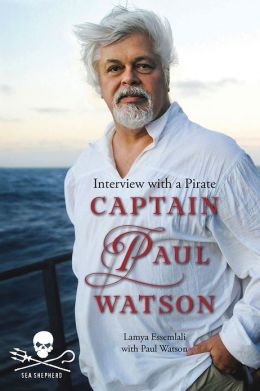
Interview with a Pirate: Captain Paul Watson


This is the biography of someone I have admired for a long time.  Paul Watson is the co-founder of Greenpeace, which he left to establish the Sea Shepherd Conservation Society.  He is a world famous eco-pirate and marine animal rights activist.  Time magazine named him one of the top twenty environmental heroes of the 20th century.  As Captain of the Sea Shepherd, he has acted as a human shield between whaling vessels and their prey and uses aggressive direct-action tactics against those who would slaughter and exploit marine resources.  He says that what people do not realize is that if we lose the animals, we will all die; the destruction of biodiversity will signal the death of humanity.  He believes that the ultimate act of goodwill toward people is to preserve the biosphere that keeps us alive.  Paul's organization prefers taking action to protesting:  they do not want to protest the whale hunt, they want to end it.  They do not serve the ecology movement, they serve the global marine ecosystem.  The fact is that we are going to lose more species of plants and animals between 2000 and 2065 than the planet has lost over the past 65 million years.  So, Paul Watson continues to work tirelessly to protect the oceans.  And, he is a happy man, because he follows the advice of Davy Crockett to "be sure you're right, then go ahead."  He has lived his life following his heart.  He has said:  "experience has taught me that the secret to happiness is detachment from material desires, a focus on the desires of the heart and a curious mind, regardless of what people might think.  Happiness is not about what you own, it's about what's in your heart, the things you try and what you do to make the world a better place, regardless of how you choose to get involved."  Petitions and banners will not be enough to save the oceans--but, committed activists like Paul Watson just might be able to accomplish it.  I, for one, am glad he's on the job.

Sunday, June 2, 2013

The House at the End of Hope Street by Menna Van Praag

 
As a fan of North Carolina writer Sarah Addison Allen, I enjoyed this magical book about an enchanted house and the women drawn to it due to their desperate need for change. The House has conditions. Its residents have 99 nights to turn their life around. The book's magic-realism is the perfect setting for the literary ghosts that live in this house, a house that gives you the things you need most to figure out the rest of your life. Charming and whimsical, this novel is just the sort of escapism most like to engage in during their summer reading.  It is fresh, whimsical, and full of heart. 

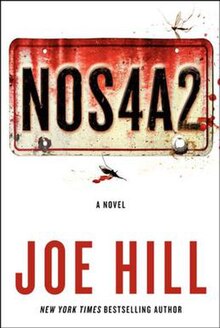
NOS4A2 by Joe Hill

 
As most of his fans already know, Joseph Hillstrom King is the son of writers Stephen and Tabitha King. This book is dedicated to his mom, "a creative thinker of the first order" who taught him to love words, search for their secret meanings, and stay attuned to their private histories. You can tell he listened to his mother, because it's the language in this book that really resonates, as well as its first-class horror story. The fact that Hill uses Christmas as a backdrop for this story (the holiday that's every kid's favorite) is pure genius. Charles Talent Manx kidnaps children and takes them to a place he calls Christmasland. Victoria McQueen's uncanny knack for finding things is her own special kind of "magic." The life-and-death battle of wills between these two is disturbing, full of twists, and a real page turner.

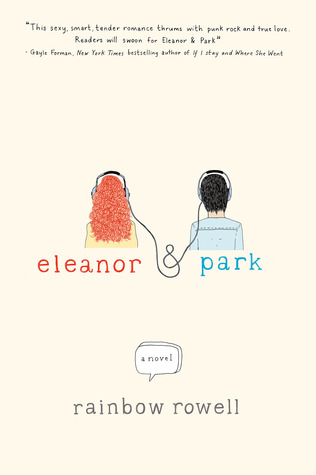
Eleanor & Park by Rainbow Rowell

 
I read this book because John Green recommended it with this quote:  "Eleanor & Park reminded me not just what it's like to be young and in love with a girl, but also what it's like to be young and in love with a book." Well, that was just too enticing to pass up.  And since I'm a huge John Green fan, his recommendation was enough for me.  And I wasn't disappointed.  It was a funny and quite touching read about two misfit kids involved in that first love relationship and their story will break your heart and leave an unforgettable  imprint on it as well.  The dialogue between the prickly Eleanor and the quiet Park is searingly honest and will have your emotions going up and down like a roller coaster.  This book is just so darn cute and pure and quirky that I'm not sure I could really do it justice in the short format I've set for these reviews.  Suffice it to say, just do yourself a favor and read it.  You'll feel all warm and fuzzy afterwards.
 

Wednesday, May 1, 2013

The Gordonston Ladies Dog Walking Club by Duncan Whitehead


As Thelma Miller's friends and fellow members of the Gordonston Ladies Dog Walking Club come together to mourn her death, the small middle class neighborhood she departed from seems to be home to a seething hotbed of secrets that play out in a delightfully droll way.  Two of her friends compete for the attention of her grieving husband, deceits and lies abound, and a killer from a mysterious organization with links to organized crime stalks the local park.  But this is only a small part of the plot; one that also involves a mysterious European gentleman in South America, a young Italian Count in Paris, an old woman with an infamous uncle who is out for revenge, a retired accountant who is hiding out and an aspiring model who wins the trip of a lifetime.  In the hands of a less capable author it would all be a little too much and probably quite muddled, but this author manages to pull it off with aplomb, making for a delightful, easy and fun read--one that I would definitely recommend.
 
It is my pleasure to welcome Duncan Whitehead to my blog today for a short interview about this book, his other works, and life in general.
 
 
Welcome Duncan.  First just let me say I was pleased to learn from your website (www.thegordonstonladiesdogwalkingclub.com ) that The Gordonston Ladies Dog Walking Club has turned into a trilogy, with Books 2 and 3 on the way.  Anything you care to share with us concerning the sequels?
Thank you.  The first sequel will touch on the back story of Ignatius Jackson but of course there will be twists and a lot of surprises.  Two new characters will be introduced, including a Detective assigned to investigate the mysterious goings on in Gordonstone. Some characters will not survive the first sequel...and a dog will find a bone in the park……..
Your English humor was in great abundance throughout the book, and you say it was actually inspired by the quirky characters in the neighborhood where you used to live in Savannah, GA.  It has been said that the south is more than a region, it’s a state of mind.  You’ve traveled extensively, do you find the southern ethos a rich one for writers?
Yes I do. Southerners, and in particularly, “Savanahnians” , have a great way with words, they can turn a simple “good morning” into a full blown conversation. They use this great descriptive language when talking, almost poetic, very similar, in my opinion to the Irish (I have also lived in Ireland).  It is my opinion, that Southerners love to talk and I love to listen!
I must admit I was intrigued by the title of the other book you’ve penned, “The Reluctant Jesus” (a comedy set in Manhattan).  Can you tell us a little bit about that one?
The Reluctant Jesus is a comedy. Unlike “Gordonston” there are no dark elements to this novel.  Seth Miller, a confirmed bachelor who is continually harassed by his domineering mother to spawn children, is told that he is the Messiah…he doesn’t want the job, in fact he is extremely annoyed.  This is compounded when he is informed that he has to battle The Antichrist, an equally as reluctant and inappropriate nominee for the role forced upon him (he has allergies and likes video games and makes Woody Allen look like Rocky!).  There are disciples, miracles, an extremely forgetful God and Devil and of course….some twists!
On a personal note, you say you are interested in the Israeli defense art of Krav Maga (that sent me to google to find out what it was—even though I am quite familiar with martial arts and am married to a second degree black belt), and the pressure point martial art Dim-Mak.  Did you get into these when you were in the military, or come to them in some other way?
I began studying Dim-Mak about 8 years ago, and didn’t really understand the concept. A few years ago I found out about a very interesting Australian man, Erle Montague, who really explained the concepts, I took it up again and even created a website (now closed) explaining some very simple techniques.  Of course it is a martial art you cannot practice much, but, it is a good skill to have, especially if you travel to places where you may need to get out of situations quickly.
I took up Krav Maga while living in Brazil.  I was explaining Dim-Mak to a friend of mine, and showed him a few defense techniques.  He then introduced me to Krav Maga, he taught it, once again I became hooked.  I began boxing when I was 14 and took up Judo when I was 11 so I have always been interested in fighting arts. 
 Since I’m all about books on this blog, how about telling me your favorite book of all time (the book you are an evangelist for), your favorite authors, and one of your favorite quotes from a book.
A Confederacy of Dunces by John Kennedy Toole.  I love this book because I think the comedy is well written and the characters, while quirky, are actually likeable. However, the reason I love this book is due to the author’s story.  His tragic life and then subsequent discover….after his death….it is kind of a great lesson in why we should never give up.   My favorite author is Agatha Christie…..I love her mysteries, the way she develops characters.  I am a big fan.  One of my favorite quotes from a book is from a “Midsummer Night’s Dream” –  If we shadows have offended, Think but this, and all is mended— That you have but slumbered here While these visions did appear. I just love it!
What is one thing your readers might be surprised to know about you?
That I love to cook! I make my own soup and I bake!
Any new projects in the works you can tell us about?
I am working on the sequels to “Gordonston” – I am also developing the first book into a screenplay as well as completing the editing and finishing touches to “Jesus”.  This week I publish a free short story “An Actor’s Life” (A dark comedy with a twist) which is available at Smashwords, Barnes and Noble and Amazon – for free if you have a device to read it on!
 Thanks for sharing a bit about yourself and your work with us today Duncan.  I'm sure we'll be hearing more from you and about you in the future.


Tuesday, April 30, 2013

Vintage photos of Librarians

Minnie Oakley and Florence Baker Hayes, two Wisconsin State Historical Society librarians, 1896.

Niagara Falls librarians, 1955.

A librarian reaching for the top shelf of the card catalog.


A librarian at the British Library of Political and Economic Science collecting books for readers in the reserve stacks, 1964.

A librarian tells a story at the Webster Branch of the New York Public Library, 1910.

This vintage photo shoot of librarians being awesome was provided by Flavorwire.  My favorite part?...where it says "librarians are likely to expand minds wherever they go--and, as such, are fully worthy of hero worship."  Smile.  I know they were certainly heroes for me when I was growing up, and I haven't changed my mind about that either.  Here's the link to the full posting.

Saturday, April 20, 2013

Cleopatra: A Life by Stacy Schiff


Cleopatra became a queen at the age of 18, married twice (each time to a brother), and at the height of her power controlled virtually the entire eastern Mediterranean coast--the last great kingdom of any Egyptian ruler.   She was 39 when she died, and had ruled for nearly 22 years (about a decade longer than Alexander the Great).  Famous long before she became notorious, according to Ms. Schiff, she has gone down in history for all the wrong reasons.

This is a scholarly treatment of the woman who spoke many languages, including the language of flattery.  She knew how to turn people to her will, and was said to be a political genius in that respect.  She wasn't a great beauty, but charisma seemed to be her dominant quality.  She was a tough, independent, capable woman with wit and humor who could blend herself into any circumstances.  They called her the Queen of Kings and she was worshipped as a goddess in her lifetime.

Schiff paints a portrait of Cleopatra that tries to separate her from the mythology and hyperbole that history has cloaked her in revealing the true woman underneath.  Not an easy task.  For as she says in this book "It has always been preferable to attribute a woman's success to her beauty rather than to her brains, to reduce her to the sum of her sex life...it is less threatening to believe her fatally attractive than fatally intelligent."

I enjoyed this book, but it is not a casual read, nor written for the casual reader.  But if you enjoy your history meticulously researched and are intrigued by this alluring but elusive woman who lived in an amazing era and was so much more than the voluptuous seductress of legend, then you might want to give it a read.

Wednesday, April 3, 2013

Suspect by Robert Crais


Maggie is a canine veteran of Iraq and Afghanistan. Scott James is an LAPD cop. Maggie lost her handler to an IED in Afghanistan, and Scott lost his partner to gunmen. And both are suffering from PTSD when they're brought together in a K9 unit.

Robert Crais is a crime and thriller writer--it's what he's known for and the type of fiction he loves to read himself. So the thriller aspect of Suspect is good, but the story of Maggie and Scott is also outstanding. Their initial mistrust of one another grows into an unbreakable bond, one that most dog lovers will recognize.

Crais wanted to write this book as accurately as our current understanding of dog behavior would allow, so he researched deeply into how dogs think, what they feel, why they feel those things, how they process the world around them, and what motivates them to do what they do. The result is not only a pretty good crime story, but also a story about one man's love affair with a dog and that dog's devotion to a man and how they are both redeemed by that love.

Saturday, March 30, 2013

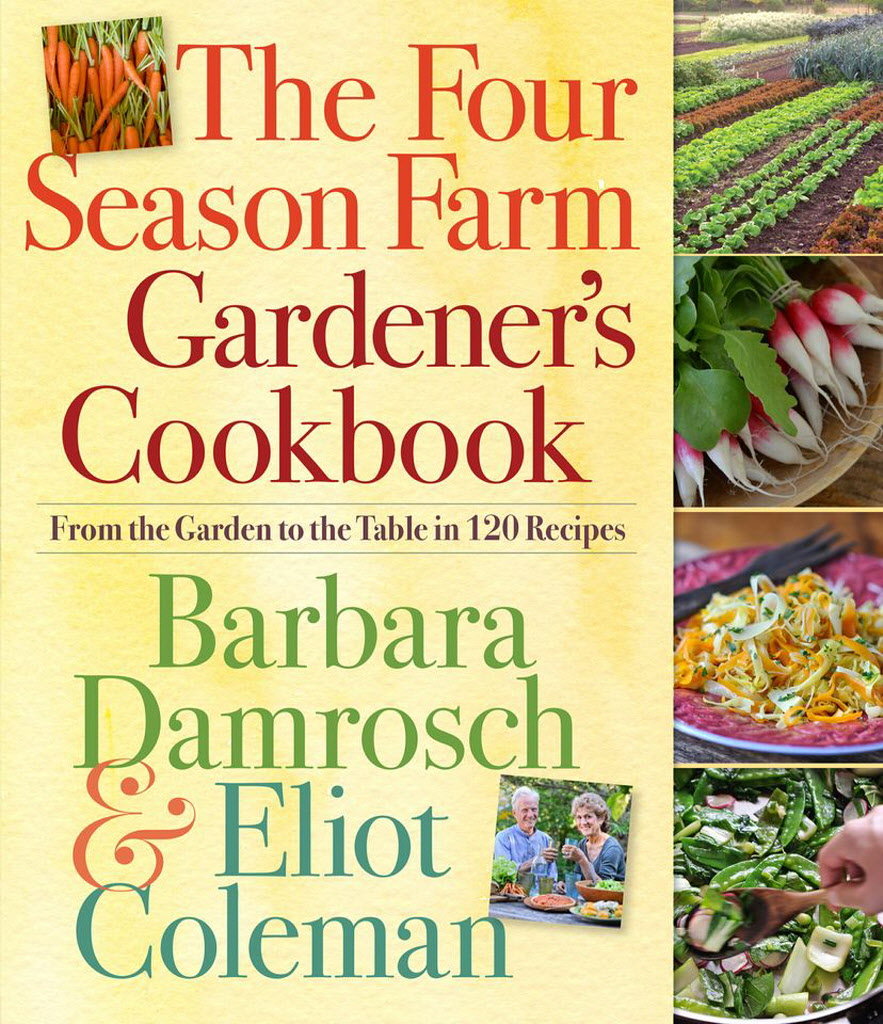
The Four Season Farm Gardener's Cookbook: From the Garden to the Table in 120 Recipes by Barbara Damrosch & Eliot Coleman


Having been a vegetarian for years, a big supporter of growing most of what you eat, and the local food movement, I was really looking forward to this latest effort from Damrosch & Coleman, two of the foremost authorities on organic gardening and sustainable living.  And it does not disappoint.  It's two books in one.  The first part of the book is devoted to actually growing what you eat, with easy to follow instructions for growing everything from the best tomatoes to berries for a pie.  It covers the basics of preparing your soil, composting, etc.  The second half of the book is a cookbook with 120 recipes to use all those lovely fruits and vegetables your labor will be providing.  And as they say, eating doesn't get any more local than your own backyard.  To me, the first couple of paragraphs in their book say it all:

"The day has begun to cool, so we reach for the sun-warmed shirts we'd shed earlier when we began cultivating the garden. The beds now look clean and tidy, the earth a dark background against which the plants stand out in rich colors. The deep green of the spinach and the bluish cast of the broccoli leaves tell us we've fed these plants well, and that they'll feed us well in return. We pull up some carrots for supper, pick a few cucumbers, dig a handful or two of potatoes, and add a head of lettuce and fresh herbs to the basket. Standing up, we stretch our backs, feeling a pleasant kind of tiredness. After washing up we fix a simple meal, much of it harvested moments before, still alive and flavorful. We feel like the luckiest people on earth.

Does this sound romantic? If so, it's only because people seldom feed themselves from their gardens anymore. Yet for much of human history, it was the normal way to live. It was something everyone needed to know how to do. Then, in the twentieth century, gardening turned into a hobby."

Run, don't walk, to your local library and check this out or to your local bookstore and purchase it for your own bookshelf. You won't be sorry.

Sunday, March 24, 2013

The Dovekeepers by Alice Hoffman

This novel set in ancient Israel took the author over five years to write.  It is a wonderful blend of history, imagination, and lyricism.  It is the tale of four women who come to Masada (a jewish fortress in the Judaean desert overlooking the Dead Sea), each by a different path, and each with secrets about who they are, where they came from, and who they love.


The history of Masada itself is quite extraordinary.  It was built by Herod the Great.  The summit of Masada sits 190 feet above sea level and about 1,500 feet above the level of the Dead Sea.  The "Snake Path" leading in climbs 900 feet in elevation. Fifteen long storerooms kept essential provisions for time of siege.  After Judaea became a province of the Roman empire, it became a refuge for the last survivors of the Jewish rebellion.  In 70 CE, nine hundred Jews held out for months against armies of Romans.  Only two women and five children survived.  Today Masada is one of the Jewish people's greatest symbols (next to Jerusalem), and Jewish soldiers take an oath there that it shall not fall again.
 
This is the tragic backdrop that is the setting for this story.  It is a story about destiny, love (how it defines us and shapes us), and sacrifice of unimaginable proportions.  It is a powerful story rich with the history of daily life two thousand years ago containing mythology and magic and told through the eyes of bold and resourceful as well as sensuous women.  


Tuesday, March 12, 2013

Loving Andrew by Romy Wyllie


Down syndrome is among the most common genetic birth abnormalities. According to the National Down Syndrome Society, 1 in 691 babies are born with Down syndrome in the United States.  When Romy Wyllie's son Andrew was born in 1959 and diagnosed as mongoloid (the term they used in those days), the prevailing medical advice was to institutionalize the child.  Although they mourned the perfect baby they had expected, they rejected the doctor's advice and followed their own natural nurturing instincts.  They took Andrew home and decided to try to give him the best life possible.  Parenting is tough under any circumstances.  The parents' role in a child's development is crucial, never more so than in the case of a child born with Down syndrome.  The provision of an enriching environment appears to accelerate cognitive development.  A high level of attention in a positive family environment and effective social and educational stimulation are critical.  These are things Romy Wyllie knew instinctively, but in 1959 with little information and no follow up, her family began their journey through the maze of parenting a developmentally disabled son.

This inspiring account of the challenges and rewards Wyllie faced while raising a Down syndrome child as an integral part of her family will appeal to a broad audience--not just caregivers and those who love and interact with a Down syndrome child or adult--but the casual reader as well.  As she says in her preface, someone with Down syndrome is first and foremost a person--a human being with a life to live and a role to play.  With modern improvement in medical technology and prenatal testing as well as the capability of terminating a less than perfect baby, it is especially important to be aware of the progress that has been made in treatment and acceptance of these very special individuals.

Wyllie does an excellent job of relating the changing societal perceptions towards the Down syndrome child over the years, compares her own experience from 1959 with those of two other families with Down syndrome children born in 1980 and 1994, and does not flinch when it comes to detailing her frustrations, mistakes, and concerns.  There is a raw honesty here that is very appealing.

It has been said that the biggest disability any of us may ever face is our own attitudes.  This moving memoir of one family's love and devotion to their son--which allowed him to master the skills of life and become a contributing member of society--will go a long way to improving societal attitudes towards those born with disabilities.

Monday, March 4, 2013

"Slow Books" Movement

U. S. independent book sellers meeting in Kansas City are optimistic.  According to this article in the Kansas City Star, the talk there has been that young audiophiles are returning to LPs and culinary types are asserting the attraction of “slow food.”  They think we could very well be witnessing a retro-fueled backlash against the digital tide. It could be more than wishful thinking that the rise of eBooks has slowed. They call the attraction of ink on paper the “slow books” movement.  Well, I've been a member of that movement for a long time...maybe many of you have too. 

Read more here: http://www.kansascity.com/2013/03/01/4092744/us-booksellers-meeting-in-kc-express.html#storylink=cpy

Wednesday, January 30, 2013

One Summer by David Baldacci


David Baldacci is a worldwide bestselling novelist.  His books have been published in over 45 languages and in more than 80 countries, with over 110 million copies in print.  He is one of the world's favorite storytellers.

This book isn't his typical offering as the writer of blockbuster thrillers, but it is a moving account of one family who learned to love and reconnect after being exposed to terrible tragedy.

It's almost Christmas, but there is no joy in the house of terminally ill Jack and his family. With only a short time left to live, he spends his last days preparing to say goodbye to his devoted wife, Lizzie, and their three children. Then, unthinkably, tragedy strikes again: Lizzie is killed in a car accident. With no one able to care for them, the children are separated from each other and sent to live with family members around the country. Just when all seems lost, Jack begins to recover in a miraculous turn of events. He rises from what should have been his deathbed, determined to bring his fractured family back together. Struggling to rebuild their lives after Lizzie's death, he reunites everyone at Lizzie's childhood home on the oceanfront in South Carolina. And there, over one unforgettable summer, Jack will begin to learn to love again, and he and his children will learn how to become a family once more.

David Baldacci is also the cofounder, along with his wife, of the Wish You Well Foundation, a non-profit organization dedicated to supporting literacy efforts across America.  You can find out more about him by going to www.davidbaldacci.com and his foundation by going to www.wishyouwellfoundation.org .  He also has a program designed to spread books across America.  You can find out more about this by going to www.feedingbodyandmind.com .

This was my first Baldacci book, but it won't be my last.  I intend to catch up on his other titles and I highly recommend him to you.

The Forgotten Garden by Kate Morton


This book was passed on to me by a Book Club member, because she thought I might like it--and, indeed I did.  It is a mystery that was released  in 2008 by Australian author Kate Morton.

On the eve of the first world war, a little girl is found abandoned on a ship to Australia. A mysterious woman called the Authoress had promised to look after her--but the Authoress has disappeared without a trace.

On the night of her twenty-first birthday, Nell O'Connor learns a secret that will change her life forever. Decades later, she embarks upon a search for the truth that leads her to the windswept Cornish coast and the strange and beautiful Blackhurst Manor, once owned by the aristocratic Mountrachet family.

On Nell's death, her grand-daughter, Cassandra, comes into an unexpected inheritance. Cliff Cottage and its forgotten garden are notorious amongst the Cornish locals for the secrets they hold--secrets about the doomed Mountrachet family and their ward Eliza Makepeace, a writer of dark Victorian fairytales. It is here that Cassandra will finally uncover the truth about the family, and solve the century-old mystery of a little girl lost.

This is a story that explores the present and the past, a theme that the author is particularly interested in.  There are three strands woven together to form a single narrative--the lives of three women from three different eras.  At first, it jumped around a little too much for me, but once I got used to jumping back and forth in time, the magical narrative captivated me.  We even get a few dark fairytales woven into the narrative as well.  You can tell that the book has been carefully researched and crafted with mysteries to be solved and many puzzle pieces to be followed till the very end (where there is a payoff).  It was a fast and easy read and the atmosphere and setting made for a compelling read.

Friday, January 25, 2013

The Joy of Re-Reading


Have to share this from Joan Wickersham from the Boston Globe about the Joy of Re-Reading.  She is so right when she says "Re-reading never gets old. The books change because we change."

Wednesday, January 23, 2013

Bibliographics

 
Read an interesting article by Suzy Staubach about the curious rise of bibliographics.  Just wanted to share it with you all here because she has a lot of good links listed for Pinterest sites and web pages having to do with books.  Truly delightful to browse for any book lover.  They make this girl's heart beat a bit faster, and maybe they will work their magic on you too.  Check it out.   

Sunday, January 13, 2013

Don't burn your books, print is here to stay!


The following article from the Wall Street Journal gives lovers of ink and paper heart.  Reports of the death of the printed book may be exaggerated.

"Ever since Amazon introduced its popular Kindle e-reader five years ago, pundits have assumed that the future of book publishing is digital. Opinions about the speed of the shift from page to screen have varied. But the consensus has been that digitization, having had its way with music and photographs and maps, would in due course have its way with books as well. By 2015, one media maven predicted a few years back, traditional books would be gone.

Half a decade into the e-book revolution, though, the prognosis for traditional books is suddenly looking brighter. Hardcover books are displaying surprising resiliency. The growth in e-book sales is slowing markedly. And purchases of e-readers are actually shrinking, as consumers opt instead for multipurpose tablets. It may be that e-books, rather than replacing printed books, will ultimately serve a role more like that of audio books—a complement to traditional reading, not a substitute.


How attached are Americans to old-fashioned books? Just look at the results of a Pew Research Center survey released last month. The report showed that the percentage of adults who have read an e-book rose modestly over the past year, from 16% to 23%. But it also revealed that fully 89% of regular book readers said that they had read at least one printed book during the preceding 12 months. Only 30% reported reading even a single e-book in the past year.

What's more, the Association of American Publishers reported that the annual growth rate for e-book sales fell abruptly during 2012, to about 34%. That's still a healthy clip, but it is a sharp decline from the triple-digit growth rates of the preceding four years.

The initial e-book explosion is starting to look like an aberration. The technology's early adopters, a small but enthusiastic bunch, made the move to e-books quickly and in a concentrated period. Further converts will be harder to come by. A 2012 survey by Bowker Market Research revealed that just 16% of Americans have actually purchased an e-book and that a whopping 59% say they have "no interest" in buying one.

Meanwhile, the shift from e-readers to tablets may also be dampening e-book purchases. Sales of e-readers plunged 36% in 2012, according to estimates from IHS iSuppli, while tablet sales exploded. When forced to compete with the easy pleasures of games, videos and Facebook on devices like the iPad and the Kindle Fire, e-books lose a lot of their allure. The fact that an e-book can't be sold or given away after it's read also reduces the perceived value of the product.

Beyond the practical reasons for the decline in e-book growth, something deeper may be going on. We may have misjudged the nature of the electronic book.

From the start, e-book purchases have skewed disproportionately toward fiction, with novels representing close to two-thirds of sales. Digital best-seller lists are dominated in particular by genre novels, like thrillers and romances. Screen reading seems particularly well-suited to the kind of light entertainments that have traditionally been sold in supermarkets and airports as mass-market paperbacks.

These are, by design, the most disposable of books. We read them quickly and have no desire to hang onto them after we've turned the last page. We may even be a little embarrassed to be seen reading them, which makes anonymous digital versions all the more appealing. The "Fifty Shades of Grey" phenomenon probably wouldn't have happened if e-books didn't exist.

Readers of weightier fare, including literary fiction and narrative nonfiction, have been less inclined to go digital. They seem to prefer the heft and durability, the tactile pleasures, of what we still call "real books"—the kind you can set on a shelf.

E-books, in other words, may turn out to be just another format—an even lighter-weight, more disposable paperback. That would fit with the discovery that once people start buying digital books, they don't necessarily stop buying printed ones. In fact, according to Pew, nearly 90% of e-book readers continue to read physical volumes. The two forms seem to serve different purposes.

Having survived 500 years of technological upheaval, Gutenberg's invention may withstand the digital onslaught as well. There's something about a crisply printed, tightly bound book that we don't seem eager to let go of."

—Mr. Carr is the author of "The Shallows: What the Internet Is Doing to Our Brains."

Friday, January 4, 2013


This book has been billed as an honest look at the price of war on an ordinary American family.  It is a story of love, loss, heroism, honor, and yes--ultimately--hope.

Michael and Jolene Zarkades are a young couple caught up in the malestrom of every day life.  He is a defense attorney, and she is the mother of two girls and a helicopter pilot with the National Guard.  Iraq erupts, and Jolene is deployed, leaving Michael to be the single parent to their two girls (a role that is obviously foreign to him).  As a mother, Jolene agonizes over leaving her family, but as a soldier she understands the true meaning of duty.  When tragedy befalls Jolene, their 12 year marriage is tested in ways that neither of them could have forseen.

The thing I liked best about this book was its depiction of the sacrifices that our service men and women make by putting themselves in harms way to protect us and ensure our freedom.  Typical of that were the words from the Soldier's Creed posted on the hospital door of Jolene's best friend Tami:

I am an American Soldier.
I am a warrior and a member of a team.
I serve the people of the United States, and live the Army Values.
I will always place the mission first.
I will never accept defeat.
I will never quit.
I will never leave a fallen comrade.
I am disciplined, physically and mentally tough, trained and proficient in my warrior tasks and drills.
I always maintain my arms, my equipment and myself.
I am an expert and I am a professional.
I stand ready to deploy, engage, and destroy, the enemies of the United States of America in close combat.
I am a guardian of freedom and the American way of life.
I am an American Soldier.

The character Jolene was a personification of this code.  I had a little trouble relating to her prior to her Iraq experience because she seemed so bottled up and controlled--a little too perfect--but that was no doubt due to her dysfunctional background, coming from an alcoholic family.  She truly found herself in the military--found her purpose.  The character of Michael was well drawn, but I found the two children very annoying.  The older girl (12) was a spoiled brat and the younger girl (4) seemed too much of a baby.

I do totally agree with Hannah when she says that no matter how you feel about war and all the political machinations behind it, we must always support our warriors. 
Related Posts Plugin for WordPress, Blogger...