Sunday, July 27, 2008

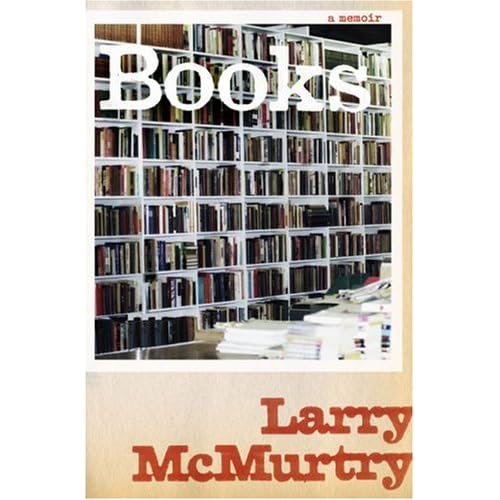
Books: A Memoir by Larry McMurtry


Larry McMurtry is a novelist whose books have been made into movies that most people would recognize: Hud, The Last Picture Show. Terms of Endearment, and the Pulitzer Prize winning novel Lonesome Dove. I must admit that I've not read any of his books, but I have seen all of the movies made from his books.

I wanted to read this book because it was written about his passion for books. McMurtry says he developed this passion despite growing up in a largely "bookless" world. He tells stories about starting out as a book scout and collector who eventually opens stores of rare and collectible editions, and I was blown away by the fact that he maintains a personal library of 28,000 volumes. This is probably a book that will appeal only to a specialized audience: booklovers, book collectors, or book fanciers, as it is filled with anecdotes about the eccentric characters that buy and sell, collect, or lust after rare books. But I feel that a few of the points that he makes towards the end of the book are worth pondering by a larger audience.

He says he nowadays has the feeling that not only are most bookmen eccentrics, but even the act they support--reading--is itself an eccentricity now. He believes that interrupted narrative has become a natural thing. Older authors like Dickens who were serially published may have started it, but the silicon chip has accelerated the process of interruption with the advent of iPods, BlackBerrys, laptops, etc. All, he says, break narrative into shorter and shorter sequences. Still, he is hopeful that someday these toys will lose their freshness and old-fashioned things like books will come to hold some interest for the masses again.

But the antiquarian book trade has declined precipitously in just the last 50 years. McMurtry bemoans that fact, and though he says he has no satisfactory answers as to why, he does provide a few clues. Few young people are forming personal libraries today. The books bought new at the chains soon trickle back into the secondhand market. But unfortunately there are fewer and fewer secondhand book shops to absorb these castoffs. The secondhand book business has existed for centuries because people want to read. But seeing the challenges that have occurred in the last few years, it begs the question: we can all survive the loss of the secondhand book trade, but can we survive the loss of reading?

And now I will quote from his book the part that really hit home to me, as a librarian:

"Today the sight that discourages book people most is to walk into a public library and see computers where books used to be. In many cases not even the librarians want books to be there. What consumers want now is information, and information increasingly comes from computers. That is a preference I can't grasp, much less share, though I'm well aware that computers have many valid uses. They save lives, and they make research in most cases a thing that's almost instantaneous. They do many good things. But they don't really do what books do, and why should they usurp the chief function of a public library, which is to provide readers access to books? Books can accommodate the proximity of computers but it doesn't seem to work the other way around. Computers now literally drive out books from the place that should, by definition, be books' own home: the library."

I agree with this statement wholeheartedly. As a librarian I am forced to remind people every day that the library is about so much more than just books. But as a dedicated book lover, they would be enough for me. I don't have to have computers or cafes or anything like that to pull me into a library. The books are what motivate and move me and capture my heart. If you are this kind of book person, you'll probably enjoy McMurtry's book.

Saturday, July 26, 2008

Gayl Jones


I just finished reading two books of poetry by Gayl Jones: "Xarque and Other Poems" and "The Hermit-Woman". As a poetry lover, I had always heard her name mentioned with glowing comments about her writing.

I looked up her biography after I read the first book. Her titles include novelist, poet, playwright, professor, and literary critic, and she was born in Lexington, Kentucky. But more disturbing to me was the chronicle of her personal life.

Her career has been marked by periods of silence, and apparently since the 1980's a withdrawal from public life. She has stated that she wanted to be known by her work and not her personal life. And really, that is quite understandable. Unfortunately her personal life became fodder for lurid headlines. Despite her accomplishments and success she seems to be quite a lonely figure and somewhat of a paranoid personality.

When she married, her husband (Bob Higgins) took the name Bob Jones. Higgins had already had several clashes with the police and was said to be a paranoid personality himself. When he was arrested after threatening someone with a shotgun, he and Gayl fled the country. Jones resigned her position (which was in Michigan at the time) with an angry letter that charged the administration with racism and, according to the New York Times, contained the sentences "Do what you want. God is with Bob and I'm with him."

The couple spent time in France and Sweden over the next few years and Gayl continued to write. When she and her husband returned to the states they moved in with Gayl's mother in Lexington. They rarely spoke to or interacted with their neighbors. Gayl's mother developed cancer and the couple became convinced that the hospital was using her secretly in medical experiments and removed her from the hospital against doctors' orders. When her mother died, they harassed hospital administrators and law enforcement officials.

When the police went to their house to serve an outstanding warrant on Bob, they found the door bolted and smelled gas. Gayle (according to the Boston Globe) dialed 911 and screamed "The state of Kentucky is damned. Get these cops out of here! The U.S. is damned. If you go to Iraq, I hope they destroy you. If you try to take my husband you'll have to kill me. You killed my mother, you'll have to kill me as well." Officers entering the house managed to subdue Gayle (who was held in a Kentucky mental hospital for 17 days), but Bob Jones slashed his own throat all the way through to the spinal cord and died instantly. "I'm sure you realize my brother-in-law was insane," Gayl Jones's brother Frank was quoted as saying in the New York Times.

Released from the hospital, Gayl stayed in Lexington and continued her reclusive life. But what a stormy and turbulent life it had been to that point.

Her writing, though criticized for what some see as an indictment against black men (portraying them as abusive husbands and lovers) still manages to show how racism and sexism build on each other. In "Hermit-Woman" the female narrator says: "I am any ordinary woman" when the lovers ask "Are you a hermit?". When asked "Does love transform?" the woman responds that "love's a danger and a promise". There are many passages in this book that prove Ms. Jones is an engaging story-teller who weaves together memorable narratives with intuitive depth and provocative implicitness. In fact, it has been said that perhaps the single strongest element in Jones's work is its evocation of human speech; she has said that she had to hear something before she could write it. Her language brings to mind improvisational jazz or the repetitions of blues music. And she always encouraged her students to write stories after listening to music.

It is a common notion that there is a fine line between creativity and insanity, and a brief perusal of history would probably support that notion. Are genius and madness related? There is something mysterious and unexplainable about the creative process. I'll leave all of that to the psychologists to sort out. I did find the writing of Gayl Jones fascinating.

Monday, July 21, 2008

The Shack by William P. Young

I love to read book jackets. I enjoy seeing what other people have to say about a book; I look for the synopsis so I can see if the book might be something that appeals to me; and I love to read about the author. In the case of The Shack, two quotes by Eugene Peterson caught my attention. The first, on the front cover, says "This book has the potential to do for our generation what John Bunyan's Pilgrim's Progress did for his. It's that good!" The second one on the back of the book said "When the imagination of a writer and the passion of a theologian cross-fertilize, the result is a novel on the order of The Shack. That definitely got my attention.

This book wrestles with the question of evil in our world and why God if he is a loving God and so powerful does not do something about it.

Mackenzie Allen Philips has a young daughter, Missy, who is abducted during a family vacation and evidence that she has probably been brutally murdered is found in an abandoned shack in the Oregon wilderness. Several years later, in the midst of what Mackenzie Philips calls his "Great Sadness", he receives a note, apparently from God, inviting him back to that shack for the weekend.

What he finds there will change his world forever. This amazing book will challenge you to more closely examine every biblical cliche and spiritual insight you thought you possessed to reveal the true nature of the divine heart of God. If you were a person who always had a lot of questions about organized religion and the struggle between tradition and truth, you may need to read this book. The beautiful way that spiritual insights are woven through the narrative of this book will delight and amaze you.

This is a book of great wisdom and insight, and it has been something of a publishing phenomena, as it has touched people's lives in various ways and continues to do so. People have ordered copies and then ordered more to share with friends. In the first four months of publication, without the book appearing in one bookstore and without any national media campaign, more than 12,000 books were sold from a single website. Their dream is to sell enough copies of the book to open the door for a feature film that the world will want to see and that will present an accurate understanding of God's character and nature to a world that longs in the deepest places of their hearts for such a God.

This book examines pain, loss, grief, anger, longing, secrets, lies, forgiveness, and presents a loving God who's purposes are accomplished every time we reach out and touch a heart or a life with kindness and service. The Shack is a beautiful story of how God can be found even in the midst of our pain and will never forsake us.

Sunday, July 13, 2008

You Can Go Anywhere: From the Crossroads of the World by Georgia Green Stamper

There were several things that made me want to read this book:

(1) The comment made by Gwyn Hyman Rubio (author of Icy Sparks) on the back of the book jacket: "Georgia Green Stamper is to Kentucky what Bailey White is to Georgia." I am a huge Bailey White fan.

(2) The quote from Silas House on the back of the jacket where he says "Georgia Green Stamper's essays do that most important thing that only the most accomplished writers are sometimes lucky to do: capture and preserve a place, a time, and its people." I adore the writing of Silas House.

(3) In the Introduction, Leatha Kendrick quotes one of my favorite passages from Edward Abbey's Desert Solitaire in evoking the power and precision of Ms. Stamper's writing to capture that time and place and people that Silas House mentions: "This is the most beautiful place on earth. There are many such places. Every man, every woman, carries in heart and mind the image of the ideal place, the right place, the one true home, known or unknown, actual or visionary."

Her essays are split into sections titled "A Little Bit of our Soul", "Family is our Unique Slant on History", "You Might as well Laugh, Mother Always Said", and "The Seasons...would always be Changing". These essays are filled with humor and insight and are very thought-provoking. The Appalachian region has a wonderful tradition of oral storytelling. Books like this, where you capture that tradition so lovingly between two covers are essential.

Georgia Green Stamper is a seventh generation Kentuckian who grew up on a tobacco farm in Owen County. She and her husband still own land that has been in the family for over a hundred and fifty years. I am an Alabama girl who's family still lives on land that my grandparents worked and who just happened to marry a Kentucky boy who lives on the land his father worked himself into an early grave over.

But I do know her people. They are my people too. And though she says her people were common folk in the eyes of the world, people of small consequence, her stories show that she appreciates growing up and being immersed in a family's culture and history. That despite the outward poverty of their lives (outhouses, coal burning stoves, drafty houses with linoleum floors, unpaved roads and one room schoolhouses), these people and this way of life had an innate wisdom and rhythm to it that is fast disappearing, and yet is wonderfully preserved in her stories. She is speaking their piece for them to anyone who will listen. And I hope that we will all cast an ear in her direction.

Saturday, July 12, 2008

Pizza, Pigs, and Poetry by Jack Prelutsky

Jack Prelutsky is the nation's first Children's Poet Laureate. He has been writing poetry for children for over forty years.

I have talked to many kids that come in and out of my library about poetry. Many of them think they don't like it. But I have never met any kid yet (nor adult for that matter) that didn't like Jack's poetry.

In this book, Jack shares with kids a little background about his life, and how he gets ideas and creates his wonderfully funny and charming poems. He gives kids good tips and techniques concerning the writing process. But the best thing he does in this book is show them how to use their imagination to turn ideas into poems.

The first thing he admits, is that he was not the best-behaved little boy in the world. In fact, I dare say after reading about the escapades of Jack and his brother, he was one of those kids that really try the patience of their parents sorely. I probably would have throttled him if he were mine. But he turns these experiences about family and pets and friends into the most delightful poems.

As an example, here's one he wrote about his father and some of the whacky things he did to him as a boy:

I Wonder Why Dad is So Thoroughly Mad

I wonder why Dad is so thoroughly mad,
I can't understand it at all,
unless it's the bee still afloat in his tea,
or his underwear, pinned to the wall.

Perhaps it's the dye on his favorite tie,
or the mousetrap that snapped in his shoe,
or the pipeful of gum that he found with his thumb,
or the toilet, sealed tightly with glue.

It can't be the bread crumbled up in his bed,
or the slugs someone left in the hall,
I wonder why Dad is so thoroughly mad.
I can't understand it at all.

This is a book that will appeal to all ages. I took it with me to a Literary Society meeting with teenagers and young adults, and they all loved it too. If you are a poet, or want to be a poet, or just want to spend some time laughing and reliving childhood, this book is a good resource.

Wednesday, July 9, 2008

Whale Song by Cheryl Kaye Tardif


Ever since I read Mind in the Waters by Joan McIntyre (a book that celebrates the consciousness of whales and dolphins) I have loved cetaceans. It breaks my heart that they are still hunted. Commercial whaling has been banned for more than two decades, but Japan, Iceland, and Norway continue firing harpoons into these gentle creatures for products that nobody needs. Orcinus Orca (the Killer Whale) is not hunted commercially, is found in all oceans of the world, and with its striking black and white coloring is one of the best known of all the cetaceans.

Another great interest of mine is Native American culture. I greatly admire the native peoples and respect the inherent wisdom of the natural world that so permeates their culture.

So this book, for me, was a natural read. And I was not disappointed. It is a well written young adult coming of age tragedy thats appeal transcends the teen audience and encompasses anyone that would enjoy a tale well told.

Sarah Richardson moves with her family to Vancouver Island just as she's about to enter the sixth grade. Sarah makes a new best friend, Goldie (a local native girl), and soaks up wisdom from Goldie's grandmother Nana. Her mother is an artist and her father is a marine biologist studying killer whales. While there, Sarah is involved in a family tragedy that will change her life forever. As Sarah is the only witness to this tragedy, and suffers hysterical amnesia, this novel is a haunting tale of choices made and how the repercussions of those choices can tear a family apart. It is an enchanting and uplifting tale that combines the optimistic spirituality of native myth with the hard realities of modern existence. The characters and descriptive setting will enthrall you.

The edition of Whale Song that I read was dedicated to the memory of the author's brother, Jason Anthony Kaye, who was brutally murdered in 2006, a week after his 28th birthday. When the police discovered his body, they set out to track down his next of kin. In the end, the police tracked her down through this book. When they asked Jason's friends about relatives in the area, they said Jason had a sister who lived on the south side of Edmonton--they didn't know her name, but they knew that she had written a book about whales. The marvels of the internet ultimately, but sadly, brought two homocide investigators to her door. What a story. You can read more about Jason at the site she has set up in his honor: http://www.jaysporchmonkeys.com/

I highly recommend this book.

Monday, July 7, 2008

Sins of the Fathers by Nash Black


O.K. I have to be honest and say that I have a connection to the authors of this book. Irene Black is a former Director of the Library where I am presently employed, a fellow book club member (we both belong to the Porch Page Turners), and a friend. I have known her and her charming husband Ford for several years now.

They have written a couple of Brewster County novels under the name Nash Black (the combined name of Irene Black and Ford Nashett)--"Qualifying Laps", and its prequel "Sins of our Fathers", as well as a non-fiction book called "Writing as a Small Business".

Since we are lucky enough to have an author as a book club member, we decided to choose "Sins of the Fathers" as our July selection for Book Club.

When movie star Marci Layne returns home to Brewster County, her high school lover turns up dead and all evidence points to her. A local lawyer and ardent fan sets out to prove she didn't kill him, based on her word alone. There are lots of twists and turns with past secrets colliding with the present till the mystery is solved.

This is a fast pleasant read, what I would call a nice little cozy mystery (with a decidedly non-cozy theme--child abuse). I had a little trouble keeping up with the characters at first, but the authors have kindly provided a list of characters in the front of the book, and it was a big help to be able to flip back to this list to reorient myself. And without giving away too much of the plot, the authors have researched the disintegration of the human personality when subjected to child molestation, and dedicate the book to the Lake Cumberland Children's Advocacy Center (with one dollar from each sale of this book being donated to the Center).

I think Brewster County may be a nice addition to some of the other fictional communities I have learned to love, from Jan Karon's Mitford to Philip Gulley's Harmony. Gotta love those small town folks and their quirky charm.

Saturday, July 5, 2008

The Dance by Oriah Mountain Dreamer


Oriah Mountain Dreamer's "The Invitation"was very popular on a lot of inspirational web sites and was passed around on a lot of emails. I don't remember how I came across it, but when I did, it made me curious about her writing...so when I saw this book advertized, I wanted to read it.


The best way to give you a taste of what her writing is like is to repeat "The Invitation" here:


"It doesn't interest me what you do for a living


I want to know what you ache for and if you dare to dream of meeting your heart's longing.


It doesn't interest me how old you are


I want to know if you will risk looking like a fool for love


for your dreams


for the adventure of being alive.


It doesn't interest me what planets are squaring your moon...


I want to know if you have touched the center of your own sorrow


if you have been opened by life's betrayals


or have become shrivelled and closed


from fear of further pain.


I want to know if you can sit with pain


mine or your own


without moving to hide it


or fade it


or fix it.


I want to know if you can be with joy


mine or your own


if you can dance with wildness


and let the ecstasy fill you to the tips of your


fingers and toes


without cautioning us to


be careful


be realistic


to remember the limitations of being human.


It doesn't interest me if the story you are telling me


is true.


I want to know if you can


disappoint another


to be true to yourself.
If you can bear the accusation of betrayal


and not betray your own soul.


If you can be faithless


and therefore trustworthy.
I want to know if you can see Beauty


even when it is not pretty


every day.


And if you can source your own life


from its presence.


I want to know if you can live with failure


yours and mine


and still stand on the edge of the lake


and shout to the silver of the full moon,


"Yes."


It doesn't interest me


to know where you live or how much money you have.


I want to know if you can get up


after a night of grief and despair


weary and bruised to the bone


and do what needs to be done


to feed the children.


It doesn't interest me who you know


or how you came to be here.


I want to know if you will stand


in the center of the fire


with me


and not shrink back.


It doesn't interest me where or what or with whom


you have studied.


I want to know what sustains you


from the inside


when all else falls away.
I want to know if you can be alone


with yourself


and if you truly like the company you keep


in the empty moments."


I guess what I like most about her writing is that she tries to challenge you to live with passion, energy, and honesty. She believes that sometimes happiness gets buried beneath the clutter of our harried lives. She tells some stories from her own experience and encourages us to slow down and return to the sacred emptiness, where we encounter our true self.


Though some of her writing at times seems to border on New Age spirituality, she herself has been an outspoken critic. She says she doesn't like sloppy thinking, a refusal to ask questions, or an easy acceptance of things we cannot know to be true because we find them comforting or far more entertaining than our everyday lives, and she sees too much of all of this in some New Age philosophies and groups and thinks it is dangerous. And yet she does write under the name Oriah Mountain Dreamer (which she took when she was studying and participating in shamanic ceremonies, it means "one who likes to push the edge) and gets some of her wisdom from a group of elders that appear to her in her dreams that she calls "the grandmothers"...so she is obviously a woman of great contradictions.


Her writing seems to me to be an interesting mix of spirituality, inspiration, love of poetry and nature, sprinkled with self deprecating humor as well as an acceptance of life's absurdities. I am usually turned off by New Age type stuff and yet I find myself charmed by her openness and disarming way of baring her own hurts and blunders in her stories. She doesn't pretend to have all the answers, but instead tries to show us how to live the questions. That I like.

Sunday, June 29, 2008

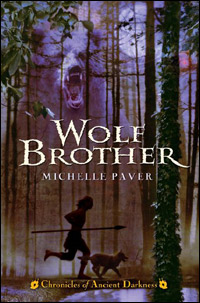
Wolf Brother


This book was recommended to me by a Shelfari friend in the Netherlands and I decided to get a copy inter-library loan and check it out. It's actually a Young Adult book that is a fast paced adventure story that delves into the world of spirits and mysticism.

When I read about the author, Michelle Paver, it said she had dreamed about running with the wild wolves in the prehistoric forest since the age of ten. Writing this book series, The Chronicles of Ancient Darkness (of which Wolf Brother is Book 1), was a way for her to fulfill this dream. To research the book she traveled through the forests of northern Finland and Lapland, slept on reindeer skins, ate lichens, forest berries, and pine resin (Stone Age chewing gum), and peered into the mouth of a very large brown bear. My kind of author.

Obviously this kind of research lends great authenticity to the writing. When young Torak witnesses the death of his father by a giant demon possessed bear, he and a wolf-cub he picks up along the way and uses for a guide set out to defeat this bear. They journey through deep forests and across giant glaciers to find their way to the mountain of the World Spirit. His journey is part of a preordained prophecy that tells about the "Listener" who will rid the forest of the bear by delivering three lost artifacts to the mountain. The author's knowledge of the animals, trees, rocks, and plants of the forest interwoven in this adventure tale really brings the story to life. I liked this book enough that it makes me want to continue on in the series, and that's the whole point isn't it?

Thursday, June 26, 2008

Patiently Observing Animals

"If thy heart be right, then will every creature be to thee a mirror of life, and a book of holy doctrine."...Thomas a Kempis, 1427

After traversing North America in 1840, John C. Fremont wrote that "It was all wild and unexplored, and the uninvaded silence roused curiosity and invited research." George Schaller's spirit resides in such places.

He was fortunate enough to have been a part of the golden age of wildlife studies, from the 1950's to the end of the twentieth century, when many large mammals for the first time became the focus of intensive research. Patiently observing animals may seem an antiquated pleasure in the age of computer modeling and remote sensing, but Schaller was a pioneer and such knowledge became the coernerstone of conservation. Nature is now viewed all too often in economic terms and treated as a commodity to be bought, sold, or discarded. Appreciation of beauty, a sense of wonder, and the ethics of taking responsibility for other species and the land seldom enter official conservation discourse now. But true conservation must reach the heart. Intimate portraits help inspire concern for their future, create a feeling of kinship, and convey that they too have a right to exist. Conservation without moral values cannot sustain itself. The book is divided into four sections: The Americas; Africa; South Asia, China, and Mongolia; and The Himalaya and the Tibetan Plateau.

The travels and studies in this book have been the basis for his scientific and popular writings. This book brings together in book form for the first time nineteen short pieces, for a unique overview of his remarkable career. His own photographs of animals and their behavior, of fieldwork, and of the author and his family, appear throughout. He has studied mountain gorillas in Central Africa and predator-prey relations in the Serengeti, as well as tigers in India and jaguars in Brazil's swamps. And then there was Schaller's groundbreaking work with giant pandas in China. This book is full of Schaller's fascinating observations.

"What is life? It is the flash of a firefly in the night. It is the breath of a buffalo in the winter time. It is the little shadow which runs across the grass and loses itself in the sunset..."Crowfoot, a Blackfoot Indian, 1890

Friday, June 20, 2008

Mountaintop Removal Movie from iLoveMountains.org

This short video on Mountaintop Removal is a must see as an adjunct to reading Missing Mountains.

Missing Mountains


I love this book. It starts out with a quote from Isaiah (one of my favorite books of the Bible) that says "They shall not hurt nor destroy in all my holy mountain..."

It has an Introduction by Silas House and an Afterword by Wendell Berry. It is a collection of essays, poems, stories, and personal testimonials by Kentuckians who oppose mountaintop removal--a coal-mining technique that destroys and devastates Kentucky's mountains and the creatures who live there.

None of these writers have a vendetta against the coal industry. They realize that coal mining is an important part of the economy, and it has allowed a hard working and determined people to rise out of poverty. But coal has been mined for decades without completely devastating the entire region. They make an eloquent plea for the proper respect to be returned to the spirit of the land and its people.

It is an emotional book that mourns the loss of woods and rolling pastures as well as the mountains themselves. The authors hope that this book will make the general public aware of the problem, and they want to use it to build hope for all the people who suffer in the shadow of mountaintop removal. It is their stories that matter. Stories of water that ran red as blood with sulfur, or one where a man had to drill five wells in a year's time because the mining blasts caused every one of them to go dry. As Silas House says in the Introduction, "It is mind-boggling that the whole nation is talking about Alaska being drilled for oil, yet no one cares that Appalachia has been systematically scalped for the last 28 years." As one woman at a town meeting said, "I don't care what anybody says, the Arctic Circle isn't a bit more worthy of respect than my mountains."

Thanks to the internet, one can view satellite photographs of the region described. Google Maps http://www.maps.google.com/ has a feature which overlays maps of highways over satellite photographs. These photographs from space clearly show the devastation. Simply search for "Ary, KY", click on satellite view, zoom in and out a bit and observe the region east of Hazard along Highway 80 between Hazard and Hindman.

As John Muir said "Thousands of tired, nerve-shaken, over-civilized people are beginning to find out that going to the mountain is going home: that wildness is necessity: that mountain parks and reservations are useful not only as fountains of timber and irrigating rivers, but as fountains of life."


Sunday, June 15, 2008

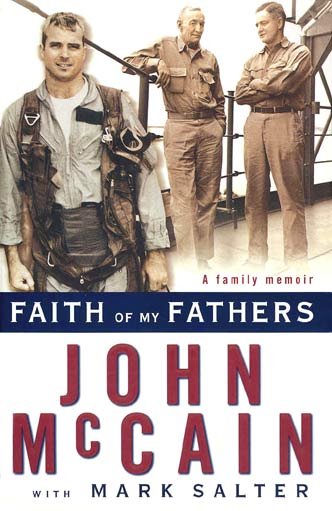
Story of Character and Courage


This book just came into the library (though it's not a new book--it was published in 1999), and I thought I would take it home and read it, because it is a book about fathers (and this weekend was Fathers Day), and because it seemed to be a book about things that mattered...faith, country, what it means to be a war hero, valor and courage. I am a person who believes that there are deep truths in life and this book seemed to explore some of them.

McCain's descriptions of his grandfather (who was a navy pilot known affectionately as Popeye by the sailors who served under him) and his father (a navy submarine commander) are interesting and balanced. He tells stories of them concerning their devotion to duty and courage, and yet also lets you see some of their flaws; their hard drinking and salty language. Both of these men rose to the rank of four-star admiral, making the McCain's the first family in American history to achieve this honor. McCain's fathers final assignment was as commander of all U.S. forces in the Pacific during Vietnam.


McCain was groomed from an early age to join the naval academy and says he never really thought of any other life path. McCain is very honest about what a poor academic record he had as a cadet and his hell-raiser attitude is not played down in this book. It was while he was serving in the Vietnam War, and shot down over Hanoi in 1967, that he would face his most difficult challenges. When his captors realized he was the son of a top commander, they offered him early release in an effort to embarrass the U.S. Acting from a sense of honor taught to him by his father and grandfather, he refused. He was tortured and held in solitary confinement for over five years.


He says that for someone who had long asserted his own individuality as his first and best defense against insults of any kind, that he discovered that faith in himself proved to be the least formidable strength he possessed when confronting organized inhumanity on a greater scale than he had conceived possible. He discovered that faith in himself was important, and remained important to his self-esteem, but he also discovered in prison that faith in himself alone, separate from other, more important allegiances, was ultimately no match for the cruelty that human beings could devise when they were entirely unencumbered by respect for the God-given dignity of man.


He said that in prison, he fell in love with his country. That he had always loved his country, but like most young people, his affection was little more than a simple appreciation for the comforts and privileges most Americans enjoyed and took for granted. It wasn't until he had lost America for a time that he realized how much he loved her.


And it was what freedom conferred on America that he loved the most--the distinction of being the last, best hope of humanity; the advocate for all who believed in the Rights of Man. Freedom is America's honor, and all honor comes with obligations. We have the obligation to use our freedom wisely, to select well from all the choices freedom offers. We can accept or reject the obligation, but if we are to preserve our freedom, our honor, we must choose well.


This book is about the lessons learned from his experience. Lessons that are very relevant to combatting the apathy and darkness prevalent in today's world.


Friday, June 13, 2008

The Wild Trees


Just finished this book, written by Richard Preston. I really liked his earlier book, "The Hot Zone" (about the spread of deadly viruses--nonfiction, written like a thriller).

This time out he opens up a whole new world talking about the largest and tallest organisms in the world--the coastal redwood trees. Yes, this is non-fiction folks, but he writes it like an interesting novel.

I have always loved trees...wouldn't want to live anywhere that was too flat and didn't have them. Reminds me of an old Seneca saying:

"When you enter a grove peopled with ancient trees, higher than the ordinary, and shutting out the sky with their thickly inter-twined branches, do not the stately shadows of the wood, the stillness of the place, and the awful gloom of this doomed cavern then strike you with the presence of a deity?"

I learned so many things about these giants that have been there for thousands of years.

  • The seeds of a redwood are released from cones that are about the size of olives.

  • Rain forest is forest that gets at least 80 inches of rain a year.

  • The California coast redwood is the tallest species of tree on earth. They range frm 350-380 feet high (35-38 stories tall)

  • The tallest trees are often slender...so not necessarily the largest

  • The main trunk of a redwood titan can be 30 feet in diameter

  • These trees could be 2,000 to 3,000 years old

  • The largest tree by volume of wood is the giant sequoia

  • The world's largest living thing is a giant sequoia named the General Sherman. It is 27 feet in diameter and 275 feet tall


And I guess what I find really amazing is that even now there are places on this planet that have never been charted or touched by human hands or feet. Wow!

Saturday, June 7, 2008

The Dewey Decimal System of Love


This book by Josephine Carr is a quirky, quick light-hearted read. It is dedicated to the extraordinary literary heritage found in our free library system and the librarians who help us discover its enduring wealth [so of course that caught my attention]. The picture on the front of a card from the old card catalog perfectly sets us up for chapters that are introduced by a little snippet telling us exactly where to find certain topics in the dewey decimal system on our non-fiction shelves. These chapter snippets and the descriptions of her everyday life in the library were my favorite parts of the book. The main character in the book, Alison Sheffield, is a reference librarian who makes you forget all those old stereotypes about librarians. She has been celibate for fifteen years but lives far from a monastic life. She loves to tool around in her convertible, listens to classical music, and is partial to ice-cold martinis. When she falls in love and falls hard, for once in her life she can't obtain the answers to her condition in a book-- she just has to experience it. And what a wild ride it is. It is romantic comedy that confronts celibacy with a touch of the absurd and a big dose of laughter.

Friday, June 6, 2008

A New Direction

I have been doing all my blogging on my MySpace page, but after a friend sent me a link to her blog on blogger.com I thought I might give it a shot here as well. Since my MySpace blogs tend to cover a wide territory but mainly in the personal realm, I thought it might be interesting to have one that dealt pretty much with my stock in trade--books.
Related Posts Plugin for WordPress, Blogger...