Sunday, September 14, 2008
Cowboys and the Internet
Saturday, September 13, 2008
Black Belt Patriotism: How to Reawaken America by Chuck Norris
In this book Chuck outlines what he thinks are the 8 most important challenges we face as a country
1) No national legacy
2) No control over spending
3) Not enough border control
4) No moral compass
5) Not enough value for human life
6) No future for children
7) No traditional values
8) No might to fight
He has appendices that include the Declaration of Independence, the Constitution of the United States, and the Ten Commandments.
In ten practical chapters he gives us insights from our founding fathers applying that wisdom to the problems of today. Among other things, he says we need to recall the purpose of government, return to a pay-as-you-go government, implement a fair tax (the ultimate economic stimulus package), cultivate a culture of peace to curb spending, secure and protect our borders, reclaim the value of human life, protect and reconnect our youth, honor and care for the family, educate ourself on health and nutrition so we will be fit for the fight, and finally reawaken the American Dream. Sounds like a pretty attractive proposal to me. Why don't you see what you think by picking up a copy of this book.
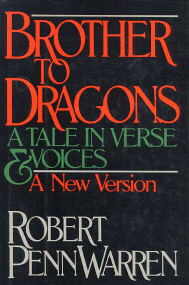
Brother to Dragons by Robert Penn Warren
[The title is a Biblical reference, Job, 30:29, listing his reasons to mourn: "I am a brother to dragons and a companion to owls."]
The year is 1811, "annus mirabilis," the year during which history records strange happenings. Floods change the courses of rivers, create lakes, sickness strikes the valley dwellers, squirrels migrate in huge numbers, pigeons scour the grain fields, a total eclipse of the sun, tornadoes, hurricanes, earthquakes rock the county. And in December of 1811 a savage crime was committed. A negro slave was brutally murdered. The perpetrators of this crime were the nephews of Thomas Jefferson--sons of his sister Lucy. Lilburne and Isham had the slave tied to a table in the meat-house and hacked him to death with an axe, casting his mutilated body parts into a roaring fire before the eyes of the other slaves. The supposed reason for this brutality was that the slave had broken a favorite pitcher of Lilburne and Isham’s dead mother. Eventually news spread about the murder (a fire-blackened bone was discovered, having been sniffed out and gnawed by a curious dog) and the brothers were arrested and indicted. After they were released on bail, Lilburne convinced his younger brother to engage in a suicide pact, according to which each brother would fire a fatal shot simultaneously into the other. Things did not go according to plan, and Lilburne was killed, while his brother survived unscathed. Isham was taken into custody again, but escaped and fled before being brought to trial.
Jefferson, despite the fact that the act was common knowledge, apparently could not bring himself to comment on or even acknowledge it, possibly because he could not accept that he, such a wealthy, prominent leader, could carry within his blood the capacity to perform such evil.
Robert Penn Warren in this long narrative poem examines the fact that while we are capable of great good, we are also capable of despicable evil. The events leading up to the murder, and the more astonishing aftermath, provide the framework for the poem. He uses multiple voices in his poem in order to give the reader a sense of fairness and lend more authority to his text. So we have a list of characters that includes Thomas Jefferson (the third President of the United States), Meriwether Lewis (with Clark, the co-commander of the Voyage of Discovery), Colonel Charles Lewis (Husband of Lucy Jefferson), Lucy Jefferson (sister of Thomas Jefferson), Lilburne Lewis (son of Charles and Lucy), Letitia Lewis (wife to Lilburne), Aunt Cat (a slave in the household of Charles Lewis, and black Mammy to Lilburne), Brother (to Letitia Lewis), Isham Lewis (brother to Lilburne), and John (the young slave). Warren himself is also a participant in the story as he moves in and out of the text contributing to the dialogue. Instead of setting the poem in 1811 and making it a traditional historical narrative, he has a set of characters meeting at a place and time not named to try and make sense of their actions.
Warren alludes to a human nature at odds with Jefferson's vision of perfectible humanity. But it is the inherited violence of slavery that profoundly impacts everybody in the poem, black and white. The ramifications of slavery are so widespread that all the poems figures are somehow complicit in the brutal act. And by inference that complicity extends to every reader.
This narrative poem says a lot about the human condition and the nature of the human heart. It's an extraordinary book.
Saturday, September 6, 2008
Aunt Jane of Kentucky by Eliza Calvert Hall
The first entry is called Sally Ann's Experience. It pits a group of women against the organized church. It was first published in Cosmopolitan in 1898. This one piece was popular in Chautauqua performances in the early twentieth century and even prompted Teddy Roosevelt to say in a speech in Lansing, Michigan in May of 1908 "I cordially recommend the first chapter of Aunt Jane of Kentucky as a tract in all families where the menfolk tend to selfish or thoughtless or overbearing disregard to the rights of their womenfolk."
Sunday, August 31, 2008
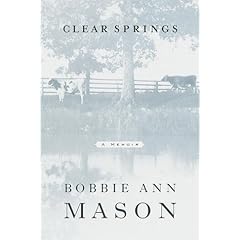
Clear Springs by Bobbie Ann Mason
The land is part of the Jackson Purchase of 1818 when Andrew Jackson signed a treaty with the Chickasaw Indian nation and the states of Kentucky and Tennessee were enlarged by approximately 2,000 and 6,000 square miles respectively. About half of the settlers were of English/Scots/Irish descent.
The charm of this book is that Mason is such a talented writer that when she concentrates her attention on her home place and home folks the lessons learned there are surprisingly applicable to the world beyond those borders.
Bobbie highlights a way of life that is fast disappearing. She talks about her ancestors being lured over the ocean to America by what she calls false advertising: "The Promised Land". Once here, they discovered they had to work hard, clearing rocks and stumps, raising livestock, killing hogs, breaking new ground, gathering dried corn in the fall, herding cows with dogs, churning, quilting, etc. Bobbie's Mother uses idioms that are dying out along with those small family farms.
Bobbie's generation left home and abandoned the old ways. They succumbed to the highway calling and the radio calling. They wanted to go places and find out what was there. They didn't want to be slaves to nature. They had found out that maintaining the Garden of Eden was too much work: hoeing, mending fences, baling hay, milking cows.
She questions this. Why wasn't it satisfying? Why did they lose their knowledge of nature? The problem with leaving is that you have to keep looking back to see where you've been. What about the charms or idealized portions of that existence? You did have to know about the Earth and her seasons; the wind, weather, and soil. What about the slow enduring pace of regular toil and the habit of mind that goes with it? The habit of knowing what is lasting and of noting every nuance of soil and water and season. She bemoans the fact that what her ancestors know is gone and only idioms linger.
These are things that we would do well to pay attention to, since Kentucky is an agricultural state ranking 4th in the nation in the number of family farms. And she concentrates on the central dynamic of the area, which is the tension of holding on to a way of life and letting in a new way. When land is spoken of these days it's in an opportunistic tone about a buck to be made. But the big money always seems to be made by someone else, not the people who know the land. There was an interesting dichotomy involved in her growing up on the farm. Though her family was clearly very self sufficient and quite capable she always felt like the country clodhopper and very inferior because they worked the soil.
Bobbie traveled around the south as president of the Hilltoppers Fan Club, spent a year in New York City, but basically spent the decade of the sixties in school. And with the 60's came the dramatic shift in society. Suddenly everything that she had strived for were the wrong goals and with the racial violence and bigotry that flooded the newsmagazines she was even more ashamed of being from the south, the home of so many lynchings. But the counterculture saved her and she met her husband and turned back towards home.
Eventually Bobbie learned to draw on that same culture that made her feel inferior and turn it into her wellspring. She became a writer and her mother was her chief inspiration. She and her husband bought a place in Kentucky and she returned to her home state because she said she had unfinished business. But she did not move all the way home to her homeplace. The land they bought was a long way from Mayfield. She had thankfully escaped the hardship of the old ways, but she wanted to live near an airport. She wanted to keep some distance and keep her options open.
When Bobbie's father dies, she has to come to terms with what to do about her Mother. All her mother's widow friends tell her the old farm is too much for her that she'd be happier moving to town and getting a smaller more manageable place. When they talk about the old times and how hard they were, her mother says "The men didn't see any need in making life easier for the women. I look back and see how women were treated and what we put up with, and I just wonder why we did it. I'm amazed." "Then don't you think it's high time you had a little something for yourself?" Bobbie answers. "Well, I'm too used to the old ways, I guess," her mother replies. Her mother manages alone for a few years, and Bobbie takes her around to look at other smaller places in Mayfield that she knows well. But her Mother finds fault with each one, and Bobbie comes to realize how important it is for her mother to keep the place in the family. It is the place where she was raised and she raised her own. It's home. She wants them to care about it and inherit it and carry it on somehow, as they used to in the old days. It is the value and meaning of the homeplace to her.
So they compromise and buy her Mom a house so that she won't have to sell the farm. She can still have her garden and go fishing and they'll rent out the farmhouse and continue to lease the fields. The farm will remain in the Mason name.
This is a wonderfully heartfelt book about home, and leaving, and coming home again, and all those life lessons learned along the way. Bobbie's prose is lyrical, like this excerpt about her parents:
"I read so much into my parents. I read the character and history of America in them as if they were a book. I read them in the ground, in the patch of grass where their barn used to be, in the sentinel yuccas by the driveway, in the lightning-scarred oak trees at the edge of the woods. I link them to the early journeys over the ocean, the revolving generations, the plow turning the furrow. While riding the rows on his tractor, Daddy mulled over the way the world works, just as I've done while sitting at the controls at my desk. I reach to know his mind, as I grab for a post, an anchor. But I always knew where my center was--here, on this land. This is my parents' greatest gift--this rootedness, this grounding. It is what has let me roam. I've been like a hawk on a gyre, flying off, ranging as far as I can--yet always spiraling back, securely tethered to home."
This is a lovely book about home and hearth, family and roots, and a touching tribute to Bobbie's mother, who was at the center of it all.
Tuesday, August 26, 2008
Entertainment Weekly's 100 Best Reads from 1983 to 2008
2. Harry Potter and the Goblet of Fire, J.K. Rowling (2000) OK, who hasn't read Rowling
3. Beloved, Toni Morrison (1987)
4. The Liars' Club, Mary Karr (1995)
5. American Pastoral, Philip Roth (1997)
6. Mystic River, Dennis Lehane (2001)
7. Maus, Art Spiegelman (1986/1991)
8. Selected Stories, Alice Munro (1996)
9. Cold Mountain, Charles Frazier (1997)
10. The Wind-Up Bird Chronicle, Haruki Murakami (1997)
11. Into Thin Air, Jon Krakauer (1997)
12. Blindness, José Saramago (1998)
13. Watchmen, Alan Moore and Dave Gibbons (1986-87)
14. Black Water, Joyce Carol Oates (1992)
15. A Heartbreaking Work of Staggering Genius, Dave Eggers (2000)
16. The Handmaid's Tale, Margaret Atwood (1986)
17. Love in the Time of Cholera, Gabriel García Márquez (1988)
18. Rabbit at Rest, John Updike (1990)
19. On Beauty, Zadie Smith (2005)
20. Bridget Jones's Diary, Helen Fielding (1998)
21. On Writing, Stephen King (2000)
22. The Brief Wondrous Life of Oscar Wao, Junot Díaz (2007)
23. The Ghost Road, Pat Barker (1996)
24. Lonesome Dove, Larry McMurtry (1985)
25. The Joy Luck Club, Amy Tan (1989)
26. Neuromancer, William Gibson (1984)
27. Possession, A.S. Byatt (1990)
28. Naked, David Sedaris (1997)
29. Bel Canto, Anne Patchett (2001)
30. Case Histories, Kate Atkinson (2004)
31. The Things They Carried, Tim O'Brien (1990)
32. Parting the Waters, Taylor Branch (1988)
33. The Year of Magical Thinking, Joan Didion (2005)
34. The Lovely Bones, Alice Sebold (2002)
35. The Line of Beauty, Alan Hollinghurst (2004)
36. Angela's Ashes, Frank McCourt (1996)
37. Persepolis, Marjane Satrapi (2003)
38. Birds of America, Lorrie Moore (1998)
39. Interpreter of Maladies, Jhumpa Lahiri (2000)
40. His Dark Materials, Philip Pullman (1995-2000)
41. The House on Mango Street, Sandra Cisneros (1984)
42. LaBrava, Elmore Leonard (1983)
43. Borrowed Time, Paul Monette (1988)
44. Praying for Sheetrock, Melissa Fay Greene (1991)
45. Eva Luna, Isabel Allende (1988)
46. Sandman, Neil Gaiman (1988-1996)
47. World's Fair, E.L. Doctorow (1985)
48. The Poisonwood Bible, Barbara Kingsolver (1998) Love all things Kingsolver
49. Clockers, Richard Price (1992)
50. The Corrections, Jonathan Franzen (2001)
51. The Journalist and the Murderer, Janet Malcom (1990)
52. Waiting to Exhale, Terry McMillan (1992)
53. The Amazing Adventures of Kavalier & Clay, Michael Chabon (2000)
54. Jimmy Corrigan, Chris Ware (2000)
55. The Glass Castle, Jeannette Walls (2006)
56. The Night Manager, John le Carré (1993)
57. The Bonfire of the Vanities, Tom Wolfe (1987)
58. Drop City, TC Boyle (2003)
59. Krik? Krak! Edwidge Danticat (1995)
60. Nickel & Dimed, Barbara Ehrenreich (2001) I love muckraker books
61. Money, Martin Amis (1985)
62. Last Train To Memphis, Peter Guralnick (1994)
63. Pastoralia, George Saunders (2000)
64. Underworld, Don DeLillo (1997)
65. The Giver, Lois Lowry (1993)
66. A Supposedly Fun Thing I’ll Never Do Again, David Foster Wallace (1997)
67. The Kite Runner, Khaled Hosseini (2003)
68. Fun Home, Alison Bechdel (2006)
69. Secret History, Donna Tartt (1992)
70. Cloud Atlas, David Mitchell (2004)
71. The Spirit Catches You and You Fall Down, Ann Fadiman (1997)
72. The Curious Incident of the Dog in the Night-Time, Mark Haddon (2003)
73. A Prayer for Owen Meany, John Irving (1989)
74. Friday Night Lights, H.G. Bissinger (1990)
75. Cathedral, Raymond Carver (1983)
76. A Sight for Sore Eyes, Ruth Rendell (1998)
77. The Remains of the Day, Kazuo Ishiguro (1989)
78. Eat, Pray, Love, Elizabeth Gilbert (2006)
79. The Tipping Point, Malcolm Gladwell (2000)
80. Bright Lights, Big City, Jay McInerney (1984)
81. Backlash, Susan Faludi (1991)
82. Atonement, Ian McEwan (2002)
83. The Stone Diaries, Carol Shields (1994)
84. Holes, Louis Sachar (1998)
85. Gilead, Marilynne Robinson (2004)
86. And the Band Played On, Randy Shilts (1987)
87. The Ruins, Scott Smith (2006)
88. High Fidelity, Nick Hornby (1995)
89. Close Range, Annie Proulx (1999)
90. Comfort Me With Apples, Ruth Reichl (2001)
91. Random Family, Adrian Nicole LeBlanc (2003)
92. Presumed Innocent, Scott Turow (1987)
93. A Thousand Acres, Jane Smiley (1991)
94. Fast Food Nation, Eric Schlosser (2001) Another muckraker...great book
95. Kaaterskill Falls, Allegra Goodman (1998)
96. The Da Vinci Code, Dan Brown (2003)
97. Jesus’ Son, Denis Johnson (1992)
98. The Predators' Ball, Connie Bruck (1988)
99. Practical Magic, Alice Hoffman (1995)
100. America (the Book), Jon Stewart/Daily Show (2004)
When I came across this list recently, I thought I would add it to this blog. It might be fun to compare your own Best Reads list to EW's. I have listed in red the ones I've read from the list. Just keep in mind, it is from Entertainment Weekly, so don't feel too bad if your list doesn't match up. I only scored 23 out of 100.
Saturday, August 23, 2008
Sweet Man is Gone by Peggy Ehrhart
Maxx lives in a scruffy little apartment in Hackensack, New Jersey and works at a waitress job that she really doesn't like very much (and is driving her crazy), but needs in order to make ends meet. Her band is finally getting some recognition, thanks to the talents of guitarist, Jimmy Nashville, who Maxx would be totally in love with if she hadn't sworn off guitar players. Which is probably just as well, because Jimmy seems to have a sea of girlfriends.
Then Jimmy plunges to his death from the window of his 9th floor apartment. Police seem inclined to believe it is a suicide, but Maxx resolves to sort out the mystery on her own. Maxx's quest to unravel the mystery takes place amidst a backdrop of blues and bar music scenes that really ring authentic and true and the blues lover will easily recognize the many references to blues tunes sprinkled liberally through the book. As Maxx digs deeper into the mysterious past of Jimmy Nashville, another death occurs, and despite a skeptical cop involved in the case and some surprising developments Maxx manages to persevere until the puzzle is solved.
With a likeable spunky sleuth and quirky characters, this book is the perfect blend of music and mystery and manages to strike just the right chords. Let's hope that this debut book is just the first of many to star Maxx Maxwell. Now, you'll have to excuse me while I go search for my blues CD's. Reading this book made me realize just how much I love that musical genre.
Monday, August 18, 2008
America! What's my Name?: The "Other" Poets Unfurl the Flag Edited by Frank X Walker
This book reminds me a little of slam poetry, a style that has become very popular among teenagers, as one of its goals is to challenge the authority of anyone who claims absolute authority over literary value.
In the Introduction to this book, Frank X Walker writes: "America needs poetry more than it needs prisons; ill-conceived government policies, inadequate schools, political spin, or exit polls. Poetry, when used correctly, is the most democratic thing we own. It belongs to the people. It is for the people and it rings truest when written by the people." So he offers this poetry anthology as a whole grain bread offering for the hungry to balance out the elitist caviar mystique of the writings of dead white males promoted by university professors and academics.
These poems range from the angry (the opening poem called "will [my] America know me when i land?" was written by Kathy Wilson before jumping from a 2nd-story window, and it is a fiery bombastic piece that is truly magnificent in its ire) to the passed over and forgotten ("Of Refuge and Language"). One of my favorites was a post 9/11 poem called "The Letting Down of Milk" which beautifully illustrates a mother's horror as she watches the skyscrapers accordion into sidewalks. There is even love interwoven in its pages with a sweet poem called "Bandit Memory".
These poems showcase angry powerful voices that cry out against gender bias, political bias, and cultural bias. As one of the poems called "Reality" says, "What we have killed in this world will rise up against us." And yet there is hope interspersed here as well, as one of the poems titled "Mother Love" says...
I lay my bones down
upon the earth
listening
to the voices
of all my relations
their lyric melodies
filling the empty places
inside of me
I lay
my bones
down
upon the earth
I rise
up
renewed
Thursday, August 14, 2008
Bare Bones by Kathy Reichs
It's a sizzling summer in Charlotte, North Carolina, and Temperance is looking forward to her first real vacation in years. A vacation that she hopes will have some romantic moments in store for her. But before she can leave a newborn's charred remains are found in a woodstove, a small plane crashes in a North Carolina cornfield, and bones (many of which seem to be of animal origin) are discovered at a remote farm outside Charlotte. So everything is put on hold until the bones are examined. At the same time that all this comes about, Temperance is dealing with her daughter Katy's new boyfriend (who she takes a dislike to) and trying to sort out her personal decisions about emotional commitment. Then someone starts trying to keep Tempe from discovering the answers. Someone is following her and her daughter and that someone needs to be stopped before it's too late.
I had always heard it said that if you like Patricia Cornwell, you'll love Kathy Reichs...that she actually does Patricia Cornwell better than Patricia Cornwell. I think I would have to agree. I like Cornwell's writing, but Reichs is undoubtedly a master crime-writing star. The book is fast paced, the dialogue engaging, and you flip the pages engaged fully in the story and curious as to how it's all going to play out. Being a forensic anthropologist must be a pretty grim job at times, and Reichs does a good job describing what those days are like. At one point in the book, Temperance says "Sometimes I think goodness and charity are racing toward extinction faster than the condor or the black rhino...Greed and callousness are winning out...Love and kindness and human compassion are becoming just a few more entries on the list of endangered species." Well said.
The other aspect of this book I really loved was the glimpse into the trade in illegal wildlife. Another direct quote from the book..."Fifty thousand plants and animals become extinct each year. Within half a century one-quarter of the world's species could be gone...one third of all U.S. plants and animals are at risk of extinction...at least 430 medicines containing 80 endangered and threatened species have been documented in the U.S. alone--at least one third of all patented Oriental medicine items available in the United States contain protected species...deer are killed for their antler velvet, Siberian tigers are hunted for their bones and penises, sea horses are killed to help men grow hair, and rhinos are shot, electrocuted, and driven into pits lined with sharpened bamboo stakes so men in Yemen can make dagger handles." That's enough to cause even the most casual animal lover to have fits of outrage.
I recommend this book highly as an entertaining and riveting read. I know I'm going to read more by Ms. Reichs now.
Sunday, August 10, 2008
The Thirteenth Tale by Diane Setterfield
I wanted to read this book because there is a love of reading, books, and stories that permeates and saturates it on every page. Let me quote a couple of passages to show you what I mean.
"There are times when the human face and body can express the yearning of the heart so accurately that you can, as they say, read them like a book."
"As one tends the graves of the dead, so I tend the books. I clean them, do minor repairs, keep them in good order. And every day I open a volume or two, read a few lines or pages, allow the voices of the forgotten dead to resonate inside my head. Do they sense it, these dead writers, when their books are read? Does a pinprick of light appear in their darkness? Is their soul stirred by the feather touch of another mind reading theirs? I do hope so. For it must be very lonely being dead."
"He removed the thermometer from my mouth, folded his arms and delivered his diagnosis. You are suffering from an ailment that afflicts ladies of romantic imagination. Symptoms include fainting, weariness, loss of appetite, low spirits...However, unlike the heroines of your favorite novels, your constitution has not been weakened by the privations of life in earlier, harsher centuries. No tuberculosis, no childhood polio, no unhygienic living conditions...I reached for the prescription. In a vigorous scrawl, he had inked: Sir Arthur Conan Doyle, The Case Book of Sherlock Holmes. Take ten pages, twice a day, till end of course."
The plot itself revolves around this love of a story well told. Vida Winter, England's most popular and reclusive writer, is dying. But before she dies, she wants to reveal the long-held secrets of her extraordinary life. She engages a young biographer, Margaret Lea, who has a few secrets of her own. This sets the stage for a multitude of plot twists and surprises that include ghosts, murder, and mayhem, and a wonderful tying up of loose ends at the end of the ride. Ms. Setterfield knows how to use the english language and her descriptive scenes remind me of a renaissance painter putting layer after layer on his canvas until just the right picture unfolds.
This is a haunting novel, rich in language, that will keep you guessing as you peel away the layers of the story. It will grab you and won't let go until the last shocking secret is revealed.
Sunday, July 27, 2008
Books: A Memoir by Larry McMurtry
Saturday, July 26, 2008
Gayl Jones

I just finished reading two books of poetry by Gayl Jones: "Xarque and Other Poems" and "The Hermit-Woman". As a poetry lover, I had always heard her name mentioned with glowing comments about her writing.
I looked up her biography after I read the first book. Her titles include novelist, poet, playwright, professor, and literary critic, and she was born in Lexington, Kentucky. But more disturbing to me was the chronicle of her personal life.
Her career has been marked by periods of silence, and apparently since the 1980's a withdrawal from public life. She has stated that she wanted to be known by her work and not her personal life. And really, that is quite understandable. Unfortunately her personal life became fodder for lurid headlines. Despite her accomplishments and success she seems to be quite a lonely figure and somewhat of a paranoid personality.
When she married, her husband (Bob Higgins) took the name Bob Jones. Higgins had already had several clashes with the police and was said to be a paranoid personality himself. When he was arrested after threatening someone with a shotgun, he and Gayl fled the country. Jones resigned her position (which was in Michigan at the time) with an angry letter that charged the administration with racism and, according to the New York Times, contained the sentences "Do what you want. God is with Bob and I'm with him."
The couple spent time in France and Sweden over the next few years and Gayl continued to write. When she and her husband returned to the states they moved in with Gayl's mother in Lexington. They rarely spoke to or interacted with their neighbors. Gayl's mother developed cancer and the couple became convinced that the hospital was using her secretly in medical experiments and removed her from the hospital against doctors' orders. When her mother died, they harassed hospital administrators and law enforcement officials.
When the police went to their house to serve an outstanding warrant on Bob, they found the door bolted and smelled gas. Gayle (according to the Boston Globe) dialed 911 and screamed "The state of Kentucky is damned. Get these cops out of here! The U.S. is damned. If you go to Iraq, I hope they destroy you. If you try to take my husband you'll have to kill me. You killed my mother, you'll have to kill me as well." Officers entering the house managed to subdue Gayle (who was held in a Kentucky mental hospital for 17 days), but Bob Jones slashed his own throat all the way through to the spinal cord and died instantly. "I'm sure you realize my brother-in-law was insane," Gayl Jones's brother Frank was quoted as saying in the New York Times.
Released from the hospital, Gayl stayed in Lexington and continued her reclusive life. But what a stormy and turbulent life it had been to that point.
Her writing, though criticized for what some see as an indictment against black men (portraying them as abusive husbands and lovers) still manages to show how racism and sexism build on each other. In "Hermit-Woman" the female narrator says: "I am any ordinary woman" when the lovers ask "Are you a hermit?". When asked "Does love transform?" the woman responds that "love's a danger and a promise". There are many passages in this book that prove Ms. Jones is an engaging story-teller who weaves together memorable narratives with intuitive depth and provocative implicitness. In fact, it has been said that perhaps the single strongest element in Jones's work is its evocation of human speech; she has said that she had to hear something before she could write it. Her language brings to mind improvisational jazz or the repetitions of blues music. And she always encouraged her students to write stories after listening to music.
It is a common notion that there is a fine line between creativity and insanity, and a brief perusal of history would probably support that notion. Are genius and madness related? There is something mysterious and unexplainable about the creative process. I'll leave all of that to the psychologists to sort out. I did find the writing of Gayl Jones fascinating.
Monday, July 21, 2008
The Shack by William P. Young
This book wrestles with the question of evil in our world and why God if he is a loving God and so powerful does not do something about it.
Mackenzie Allen Philips has a young daughter, Missy, who is abducted during a family vacation and evidence that she has probably been brutally murdered is found in an abandoned shack in the Oregon wilderness. Several years later, in the midst of what Mackenzie Philips calls his "Great Sadness", he receives a note, apparently from God, inviting him back to that shack for the weekend.
What he finds there will change his world forever. This amazing book will challenge you to more closely examine every biblical cliche and spiritual insight you thought you possessed to reveal the true nature of the divine heart of God. If you were a person who always had a lot of questions about organized religion and the struggle between tradition and truth, you may need to read this book. The beautiful way that spiritual insights are woven through the narrative of this book will delight and amaze you.
This is a book of great wisdom and insight, and it has been something of a publishing phenomena, as it has touched people's lives in various ways and continues to do so. People have ordered copies and then ordered more to share with friends. In the first four months of publication, without the book appearing in one bookstore and without any national media campaign, more than 12,000 books were sold from a single website. Their dream is to sell enough copies of the book to open the door for a feature film that the world will want to see and that will present an accurate understanding of God's character and nature to a world that longs in the deepest places of their hearts for such a God.
This book examines pain, loss, grief, anger, longing, secrets, lies, forgiveness, and presents a loving God who's purposes are accomplished every time we reach out and touch a heart or a life with kindness and service. The Shack is a beautiful story of how God can be found even in the midst of our pain and will never forsake us.
Sunday, July 13, 2008
You Can Go Anywhere: From the Crossroads of the World by Georgia Green Stamper
There were several things that made me want to read this book:(1) The comment made by Gwyn Hyman Rubio (author of Icy Sparks) on the back of the book jacket: "Georgia Green Stamper is to Kentucky what Bailey White is to Georgia." I am a huge Bailey White fan.
(2) The quote from Silas House on the back of the jacket where he says "Georgia Green Stamper's essays do that most important thing that only the most accomplished writers are sometimes lucky to do: capture and preserve a place, a time, and its people." I adore the writing of Silas House.
(3) In the Introduction, Leatha Kendrick quotes one of my favorite passages from Edward Abbey's Desert Solitaire in evoking the power and precision of Ms. Stamper's writing to capture that time and place and people that Silas House mentions: "This is the most beautiful place on earth. There are many such places. Every man, every woman, carries in heart and mind the image of the ideal place, the right place, the one true home, known or unknown, actual or visionary."
Her essays are split into sections titled "A Little Bit of our Soul", "Family is our Unique Slant on History", "You Might as well Laugh, Mother Always Said", and "The Seasons...would always be Changing". These essays are filled with humor and insight and are very thought-provoking. The Appalachian region has a wonderful tradition of oral storytelling. Books like this, where you capture that tradition so lovingly between two covers are essential.
Georgia Green Stamper is a seventh generation Kentuckian who grew up on a tobacco farm in Owen County. She and her husband still own land that has been in the family for over a hundred and fifty years. I am an Alabama girl who's family still lives on land that my grandparents worked and who just happened to marry a Kentucky boy who lives on the land his father worked himself into an early grave over.
But I do know her people. They are my people too. And though she says her people were common folk in the eyes of the world, people of small consequence, her stories show that she appreciates growing up and being immersed in a family's culture and history. That despite the outward poverty of their lives (outhouses, coal burning stoves, drafty houses with linoleum floors, unpaved roads and one room schoolhouses), these people and this way of life had an innate wisdom and rhythm to it that is fast disappearing, and yet is wonderfully preserved in her stories. She is speaking their piece for them to anyone who will listen. And I hope that we will all cast an ear in her direction.
Saturday, July 12, 2008
Pizza, Pigs, and Poetry by Jack Prelutsky
Wednesday, July 9, 2008
Whale Song by Cheryl Kaye Tardif
Ever since I read Mind in the Waters by Joan McIntyre (a book that celebrates the consciousness of whales and dolphins) I have loved cetaceans. It breaks my heart that they are still hunted. Commercial whaling has been banned for more than two decades, but Japan, Iceland, and Norway continue firing harpoons into these gentle creatures for products that nobody needs. Orcinus Orca (the Killer Whale) is not hunted commercially, is found in all oceans of the world, and with its striking black and white coloring is one of the best known of all the cetaceans.
Another great interest of mine is Native American culture. I greatly admire the native peoples and respect the inherent wisdom of the natural world that so permeates their culture.
So this book, for me, was a natural read. And I was not disappointed. It is a well written young adult coming of age tragedy thats appeal transcends the teen audience and encompasses anyone that would enjoy a tale well told.
Sarah Richardson moves with her family to Vancouver Island just as she's about to enter the sixth grade. Sarah makes a new best friend, Goldie (a local native girl), and soaks up wisdom from Goldie's grandmother Nana. Her mother is an artist and her father is a marine biologist studying killer whales. While there, Sarah is involved in a family tragedy that will change her life forever. As Sarah is the only witness to this tragedy, and suffers hysterical amnesia, this novel is a haunting tale of choices made and how the repercussions of those choices can tear a family apart. It is an enchanting and uplifting tale that combines the optimistic spirituality of native myth with the hard realities of modern existence. The characters and descriptive setting will enthrall you.
The edition of Whale Song that I read was dedicated to the memory of the author's brother, Jason Anthony Kaye, who was brutally murdered in 2006, a week after his 28th birthday. When the police discovered his body, they set out to track down his next of kin. In the end, the police tracked her down through this book. When they asked Jason's friends about relatives in the area, they said Jason had a sister who lived on the south side of Edmonton--they didn't know her name, but they knew that she had written a book about whales. The marvels of the internet ultimately, but sadly, brought two homocide investigators to her door. What a story. You can read more about Jason at the site she has set up in his honor: http://www.jaysporchmonkeys.com/
I highly recommend this book.
Monday, July 7, 2008
Sins of the Fathers by Nash Black

Saturday, July 5, 2008
The Dance by Oriah Mountain Dreamer
If you can bear the accusation of betrayal
I want to know if you can see Beauty
I want to know if you can be alone
Sunday, June 29, 2008
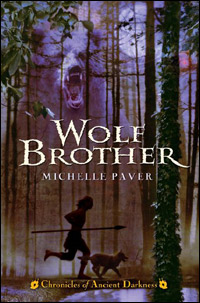
Wolf Brother
This book was recommended to me by a Shelfari friend in the Netherlands and I decided to get a copy inter-library loan and check it out. It's actually a Young Adult book that is a fast paced adventure story that delves into the world of spirits and mysticism.
When I read about the author, Michelle Paver, it said she had dreamed about running with the wild wolves in the prehistoric forest since the age of ten. Writing this book series, The Chronicles of Ancient Darkness (of which Wolf Brother is Book 1), was a way for her to fulfill this dream. To research the book she traveled through the forests of northern Finland and Lapland, slept on reindeer skins, ate lichens, forest berries, and pine resin (Stone Age chewing gum), and peered into the mouth of a very large brown bear. My kind of author.
Obviously this kind of research lends great authenticity to the writing. When young Torak witnesses the death of his father by a giant demon possessed bear, he and a wolf-cub he picks up along the way and uses for a guide set out to defeat this bear. They journey through deep forests and across giant glaciers to find their way to the mountain of the World Spirit. His journey is part of a preordained prophecy that tells about the "Listener" who will rid the forest of the bear by delivering three lost artifacts to the mountain. The author's knowledge of the animals, trees, rocks, and plants of the forest interwoven in this adventure tale really brings the story to life. I liked this book enough that it makes me want to continue on in the series, and that's the whole point isn't it?
Thursday, June 26, 2008
Patiently Observing Animals
Friday, June 20, 2008
Mountaintop Removal Movie from iLoveMountains.org
This short video on Mountaintop Removal is a must see as an adjunct to reading Missing Mountains.
Missing Mountains
I love this book. It starts out with a quote from Isaiah (one of my favorite books of the Bible) that says "They shall not hurt nor destroy in all my holy mountain..."
It has an Introduction by Silas House and an Afterword by Wendell Berry. It is a collection of essays, poems, stories, and personal testimonials by Kentuckians who oppose mountaintop removal--a coal-mining technique that destroys and devastates Kentucky's mountains and the creatures who live there.
None of these writers have a vendetta against the coal industry. They realize that coal mining is an important part of the economy, and it has allowed a hard working and determined people to rise out of poverty. But coal has been mined for decades without completely devastating the entire region. They make an eloquent plea for the proper respect to be returned to the spirit of the land and its people.
It is an emotional book that mourns the loss of woods and rolling pastures as well as the mountains themselves. The authors hope that this book will make the general public aware of the problem, and they want to use it to build hope for all the people who suffer in the shadow of mountaintop removal. It is their stories that matter. Stories of water that ran red as blood with sulfur, or one where a man had to drill five wells in a year's time because the mining blasts caused every one of them to go dry. As Silas House says in the Introduction, "It is mind-boggling that the whole nation is talking about Alaska being drilled for oil, yet no one cares that Appalachia has been systematically scalped for the last 28 years." As one woman at a town meeting said, "I don't care what anybody says, the Arctic Circle isn't a bit more worthy of respect than my mountains."
Thanks to the internet, one can view satellite photographs of the region described. Google Maps http://www.maps.google.com/ has a feature which overlays maps of highways over satellite photographs. These photographs from space clearly show the devastation. Simply search for "Ary, KY", click on satellite view, zoom in and out a bit and observe the region east of Hazard along Highway 80 between Hazard and Hindman.
As John Muir said "Thousands of tired, nerve-shaken, over-civilized people are beginning to find out that going to the mountain is going home: that wildness is necessity: that mountain parks and reservations are useful not only as fountains of timber and irrigating rivers, but as fountains of life."